DIVERSE AND ECLECTIC FUN FOR YOUR EARS - 60s to 90s rock, prog, psychedelia, folk music, folk rock, world music, experimental, doom metal, strange and creative music videos, deep cuts and more!
Saturday, May 17, 2025
Steeleye Span - Awake, Awake
Having held together for what was in Steeleye Span terms an eternity, the classic line up of the band finally came to an end in 1977 with the departure of Bob Johnson and Peter Knight. The two had initially been granted leave by the record company to work on a side project, but they simply did not return. Most significantly, this meant that the band were without a fiddle player for the first time since their debut.
On the plus side, the surprise return of the great Martin Carthy filled the lead guitar position perfectly. Carthy brought with him accordionist John Kirkpatrick, whom Carthy had unsuccessfully tried to introduce to the band when he had joined previously. It seems it was always recognised however that Carthy and Kilpatrick's participation in the band would be a temporary one.
The title refers in part at least to this being the band's tenth album. "Storm force ten" actually includes some fine prog folk material, including the wonderful 8½ minute "The victory". This was in many ways one in the eye for those who abandoned the band as a result of "All around my hat", reassuring the faithful that Steeleye Span were still quite capable of complex arrangements, excellent instrumentation and outstanding vocal harmonies. "The victory" contains all of these in bucket loads, and must surely rate as the band's most under appreciated song.
Elsewhere on side one of the album, we have the slower but equally striking opener "Awake awake" and a couple the light vocal tracks "Sweep, Chimney Sweep" and "The Wife of the Soldier". "The Wife of the Soldier" and "The Black Freighter [From The Threepenny Opera]" are interesting as they are not traditional pieces but poems by early 20th century writer Bertolt Brecht set to music by Patrick John Scott and Kurt Weill respectively. Being extracted from a bona fide opera, "The black freighter" sounds rather different to the usual Steeleye Span fare. The presence of accordion and Maddy Prior's vocal style still offer a connection with folk, but there is no denying the operatic nature of the material.
"Some rival" is the most orthodox song here, Maddy delivering the simple melody through a beautiful vocal performance, accompanied by acoustic guitars. The multi-track harmonisation of Maddy’s voice and a peaceful flute solo only add to the appeal of this very old folk song. "Treadmill song" describes a device used in prisons as a form of punishment in the 19th century. The rhythm reflects the drudgery of walking upon the treadmill for hours on end, with drum raps suggesting the occasional flick of the whip to suppress any slacking. The album closes with " Seventeen Come Sunday", a song based on writings by Scottish poet Robert (Rabbie) Burns. This is as close as we get to a jig on the album, Kilpatrick's accordion playing being jaunty and spirited. The song tells the tale of a one night stand, the soldier deciding that "The fife and drum is my delight".
The constant presence of accordion in place of fiddle immediately gives this album a different flavour, even when the material is similar to that on previous albums. The ambitious nature of some of the tracks, the inclusion of the sublime "The victory" and the cod operatic "The black freighter" offer concrete reassurance that the band are not prepared to simply sit on their laurels, but are keen to continue to develop their music. From: https://www.progarchives.com/album.asp?id=19867
Chris Isaak – Go Walking Down There
Chris Isaak: Who do you write for?
MF: A high-end audiophile magazine.
CI: That’s what this interview is for?
MF: Yes. I’m the popular music editor.
CI: Popular music? What does that have to do with me?
MF: I’m also the unpopular music editor.
CI: The RCA stuff that Elvis did, I think it’s some of the best sounding…the quality of the sound for the time it was. People always say, “Well nowadays we got the compact disk, we got this and that,” and they say “That stuff doesn’t stand up.” Well, crank that stuff up in your car, and crank up anything else you want to play and it stands up fine! It’s always interesting, half the time you talk to these guys (older heroes, whether musicians or engineers), and they say, “Yeah, I got that sound, but I don’t want to do that anymore, now we’ve got digital recording…” A lot of times you go back to your hero and you go, “What a great sound you had on those old Gretsches.” And he goes “Gretsch? Peavey, man! Tube amp? Forget the tube amps, we got this new one,” and you kind of just go, “Oh God!”
MF: How conscious are you of sound quality?
CI: Very.
MF: I think you have created a musical and visual image that blends Fifties and Eighties sensibilities into something new, but your recordings tend to produce a sonic clash of values to my ears.
CI: I try to get the Eighties sound. I think that to go back and say I want this to sound like a Fifties recording…There are some aspects of our sound that are old fashioned, or classic, or whatever you want to call it—the vocal being way on top of the mix—trying to leave a lot of space for the guitar, using echoes that are big and clear. My idea of a good echo is a big room sound. I always heard about the RCA building where they used a staircase or the church next door or something. And Buddy Holly recording in a big ballroom, I think. They use actual big space. I like that kind of feeling. But there are certain things they do now on some stuff, for example, the punch of the electronic drums. That real heavy beautiful sound. The clarity of different tracks. I like that. People who don’t have trained ears or who aren’t listening carefully say, “Oh, you don’t use synthesizers and drum machines.” Well, they’re wrong. I’ve used drum machines, synthesizers, I’ve used multi-track and double-track and slave-tracked, cross cut—anyway I can, to get what I want.
MF: Do you think a live album of your performances would be effective?
CI: Could be. Certain songs would be good live, because I have a swinging band and they could cut it live.
MF: Have you thought about cutting a studio album “live”?
CI: I’ve thought about it because I work with Lee Herschberg as an engineer, and he’s worked with just about everybody I think is good, and he’s got so much experience. It’s like question-and-answer period with him. I mean I don’t even know to ask him intelligent questions, half the time. You describe to him what you want, and you get it. But I’d like to make a one-microphone recording with him. One mike in a room and everybody sings…I’ve always liked recordings where people played live together. If you listen to the old Stones records you can kind of hear where the people in the room were standing, almost.
MF: Even in mono.
CI: It sounds like they’re in a room playing. And now it doesn’t sound like that. It sounds like the singer sings through that little speaker, but they don’t sound like they’re placed in a room, because there’s not an echo that’s all blending into one microphone, anywhere. I like the idea of going for a one-take recording and doing 25 takes, you know? I bet you could take about 99 percent of the people out there singing today—big stars—and you put them in a one-track recording, and they’d be out of the business. They cannot sing! I think I can sing. There’s a lot of things I don’t have going for me, but I think I can sing.
MF: What don’t you have?
CI: Musically, I don’t know how good a songwriter I’m going to be. And as a singer, I think I have a pretty good voice, but I don’t know about my style. I’m still trying to find my own strong style. In songwriting, when you compare yourself to someone like John Lennon, you feel like shooting yourself.
MF: Everybody does.
CI: I met Roy Orbison. I wish I could have written one of the songs he’s done. I mean, he’s got 15 songs that I haven’t touched that height.
MF: Well you’re on your way. There is a lot of real emotion in your songs, compared to some of the wallpaper that’s out there… you write a lot in minor keys.
CI: I like that. I’ll probably continue to write a lot of stuff in minor key. I really like that sound. It’s up to me to expand. I’m trying to write a little bit on piano. I don’t know how to play piano, but I bought one. A real one.
From: https://trackingangle.com/features/we-caught-a-rising-star-chris-isaak
Hair - The Original Broadway Cast - Easy To Be Hard
Most rock fans know the song ‘Easy To Be Hard’ by Three Dog Night’s hit version, but the original recording is from the 1968 Broadway Cast of the musical Hair – The American Tribal Love-Rock Musical. The show introduced the hits “Aquarius/Let The Sunshine In,” “Good Morning Starshine” and the title song which were brought to the charts by the likes of The Fifth Dimension, Oliver and The Cowsills respectively. All of the songs in the musical were written by Galt MacDermot, Gerome Ragni and James Rado. MacDermot also wrote the music to the 1971 musical Two Gentlemen Of Verona and released several influential funk and instrumental jazz albums that are currently the rage amongst those “in the know” of the hipster cognoscenti.
I’ve been listening to this record since I was seven years old…way before I knew the meaning of “Sodomy,” “Hashish,” “Colored Spade,” “Walking In Space” and the numerous other titillating-for-their-time songs in this musical. It is indeed part of my musical DNA. The cast album to Hair has managed to stand the test of time and the musical has enjoyed numerous successful revivals and tours around the world. The musical was also taken to the big screen in 1979 by director Milos Forman with choreography by Twyla Tharpe, introducing it to numerous later generations. From: https://internetfm.com/song-of-the-day-easy-to-be-hard-by-lynn-kellogg/
Genesis - Visions of Angels
Most critics view 1971's Nursery Cryme as the first classic Genesis album – the band's progressive watershed. It's a logical view: Their third LP brought drummer Phil Collins and guitarist Steve Hackett into the fold, cementing the most dynamic lineup in prog-rock history. But that hype unjustly overshadows what came before: Trespass, the crucial turning point in the band's discography.
The album, released on Oct. 23, 1970, abandoned the precious teenage twiddling of the previous year's over-produced From Genesis to Revelation. Freed from the smothering production of Jonathan King, the band dove into fanciful imagery and lush, long-form arrangements, helping cement the folk-prog sub-genre.
"From the beginning, we'd set out as songwriters," singer Peter Gabriel reflected in the album's reissue interview series. "And we were quite happy to be writing what were effectively pop songs. But I think there was always inside of us a yearning to explore, to push the boundaries and to mix styles. And as we started to get a little more adventurous, it got too out of mainstream, left-field for Jonathan and for the publisher we were working with."
The album was recorded at London's Trident Studios during June and July 1970, which guitarist Anthony Phillips calls "the summer of many drummers" – a reference to their ever-revolving drum throne. Though influenced by late-'60s psychedelia and the experimentation of Family, Procol Harum and Fairport Convention, Trespass found the band merging their disparate backgrounds – Gabriel's love of soul music, Tony Banks' classical and pop expertise and the ethereal 12-string folk of Phillips and Mike Rutherford – into an unusual new style.
"The folk sound was definitely from Ant and Mike and this 12-string combination," Gabriel noted. "I think that was really quite innovative. And I loved it and tried to encourage it from my point of view.
Tracks like "White Mountain" were based predominantly on the pastoral twin 12-string attack, while heavier rockers like "Looking for Someone" and "The Knife" (originally titled "The Nice," as a nod to Keith Emerson's keyboard-heavy group) originated from the Banks-Gabriel camp. The most collaborative piece – and the one that Banks acknowledges as the album's peak – is the majestic, nine-minute epic "Stagnation," which combines both of these extremes. (Gabriel referred to the track as a "journey song," navigating through a "series of landscapes.")
Trespass feels like an outlier in the Genesis oeuvre because it's so damn gentle – "Dusk," in particular, breezes by without any sense of urgency. But considering the heavy input of Phillips, the de facto leader, this band is very different from the quintet that created Nursery Cryme.
Phillips, suffering from intense stage fright exacerbated by health issues, soon announced his departure – a decision that left the band scrambling. “We went back on the road and I just couldn’t do it," the guitarist told The Telegraph in 2014. "I had to tell Mike. It was difficult, but I knew I was going to hold them back.”
With it’s quiet reception, the album didn't thrust the band into stardom (though it did curiously land at No. 1 on the Belgian charts), and Phillips' exit only intensified their anxieties. But Genesis rebounded with renewed focus and firepower for Nursery Cryme, taking another massive creative leap.
Looking back, Trespass is more than just a crucial link to the classic era – it's the sound of Genesis discovering their songwriting strengths. "If you look at, say, Crosby, Stills, Nash, & Young, 10CC, other bands which are songwriter-based, rather than musician-based, I think you do see long life spans," Gabriel said. "It's a different sensibility. Most bands begin playing together and then find writing, whereas we wanted to write and we found playing." From: https://ultimateclassicrock.com/genesis-trespass/
Ciccada - Who's To Decide
‘Harvest’ - Ciccada. There is just no way that this can be the third album from a Greek band, as surely this is a long-lost British act from the early/mid Seventies. I mean, the obvious reference points straight out of the hat are Gryphon and Gentle Giant, they don't get more British than that, with some elements of Renaissance, Tull, Hatfield, but never a whiff of Vangelis or Aphrodite's Child! I just made a quick check over to ProgArchives to see what the most highly rated Greek progressive album of all time is, and I was somewhat surprised to see that it is actually this one! I really thought it would be '666', but rather aptly that is currently at #6 on the list. Ciccada are Dimi Spela (vocals), Evangelia Kozoni (vocals), Yorgos Mouhos (6- and 12- string acoustic guitars, electric guitar, vocals), Nicolas Nikolopoulos (flute, clarinet, tenor & baritone saxophones, recorder, piano, electric piano, organ, Mellotron, synthesisers, harpsichord, Clavinet, glockenspiel, backing vocals), Marietta Tsakmakli (soprano, alto and baritone saxophones, backing vocals), Aggelos Malisovas (fretted and fretless basses), and Yiannis Iliakis (drums, percussion, backing vocals). I guess they either use backing tracks or bring in additional performers when they play live, as there is no way Nikolopoulos can do all that is being asked of him, as this is multi-layered, and he is often providing multiple instruments at the same time.
There is just so much going on here, with complex arrangements, yet at times the music also feels quite gentle with plenty of folk elements also being included. They also mix the vocals, using male when the time is right, which gives a different feeling to the music, yet it is the classic sounds from the keyboards combined with the multiple elements of woodwind and brass which makes this stand out. It really is as if Gryphon have been reincarnated, and part of me really wishes they had brought out the crumhorns. There is a huge depth and breadth to this music, and it reminds me so much of why I started listening to this style of music more than 40 years ago as there is just so much going on, combing musicality with versatility and melody to create something that is both enjoyable and awe inspiring all in one go. From: https://www.progarchives.com/artist.asp?id=5668
Black Sabbath - The Thrill of It All
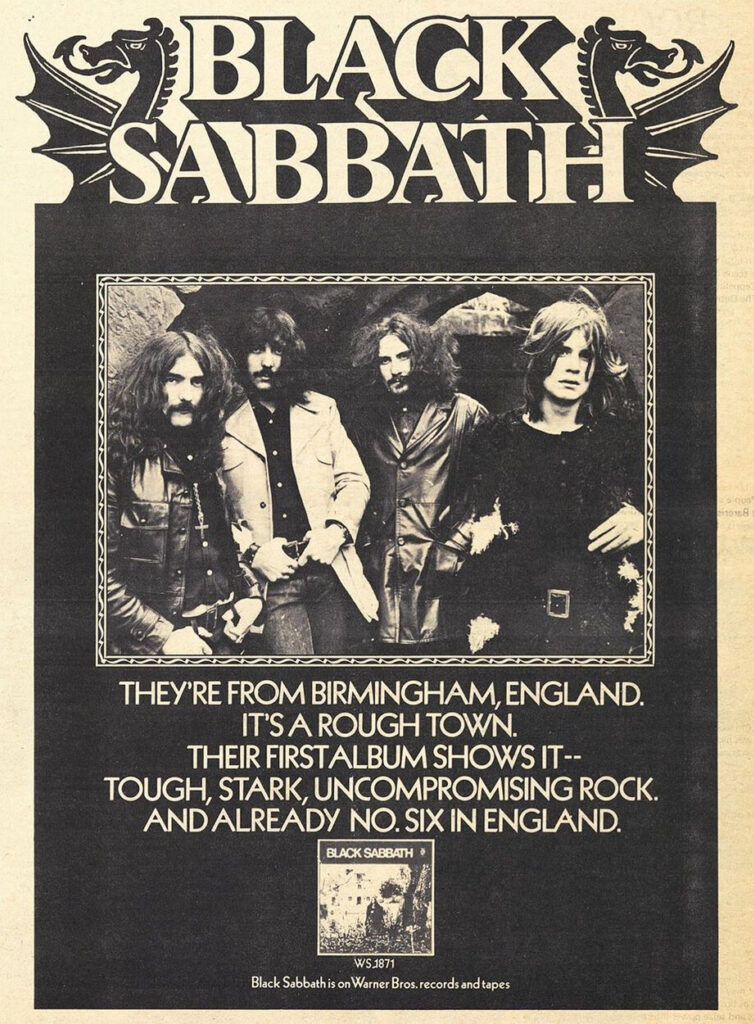
Objectively, is there any reason to think Sabotage is really any less of a Black Sabbath classic than Paranoid or Master of Reality? Most fans act like it’s just a given that Sabotage isn’t on the same level, and most of those phony internet “Black Sabbath albums ranked” lists reinforce that point. Kerrang puts it at #9 (behind Dehumanizer and Headless Cross??? Heaven and Hell I can understand, but not sure what they were smoking when it comes to the others). Loudwire puts it at a slightly more defensible #8, behind both Heaven and Hell and Mob Rules. Mojo rates it at #6, while those most prestigious of all internet classic rock rankers, Ultimate Classic Rock, puts it at #7 (with the debut album at #3??? Really???). I’ll never know why I find these ridiculous lists so ridiculously addictive, but I have both never seen one I agree with and never seen one I was able to resist reading.
Anyway, while there may be minor quibbles about exact placement, in ranking Black Sabbath albums there is a universal consensus that Sabotage sits a rung below Paranoid, Master of Reality, and Vol. 4. But I’d maintain it isn’t the quality of the album itself that causes anyone to think that way, but rather its sequential place in their discography. I’d argue that Sabotage is every bit as good as the aforementioned albums, and the only reason nobody thinks so is because by the sixth album of pretty much the exact same thing, fans had gotten pretty familiar with the Black Sabbath formula, and we all know what familiarity breeds. The reasons fans saw it as a step down wasn’t because it was any less than, but because it was the same as a bunch of earlier albums that didn’t have a lot of variety to begin with, and it was easy to get Sabbathed out with all the samey same all the time. Switch Paranoid and Sabotage in the order of release, and it would be the latter seen as the classic, and the former as a step down in quality. Because they are more or less the same album – which can be said of pretty much each of the first six Black Sabbath albums (excepting a few moments on Sabbath Bloody Sabbath where they mixed it up a bit, such as on the marvelous “Spiral Architect” and on a couple of misguided synthesizer mishaps). By the time Sabotage came along, the Black Sabbath sound was no longer as fresh as it was when Paranoid and Master of Reality were released. I’d argue that, and that alone, is the only reason Sabotage isn’t generally regarded as one of the greatest Black Sabbath albums. From: https://brutallyhonestrockalbumreviews.wordpress.com/2024/10/24/album-review-black-sabbath-sabotage-which-id-argue-is-just-as-good-or-maybe-better-than-paranoid/
22 Brides - Jane
22 Brides sisters Carrie and Libby Johnson have traveled the world, played in punk bands and in geisha houses, worked in a pet store and one of them had a brief stint as a phone sex operator. These worldly influences, as well as a passion for gutsy pop, come together to form their self-titled release on Zero Hour. While on the surface it usually coasts prettily along, sooner or later, a vocal snags your ear, or a powerful guitar jam gives you a start. From: https://lollipopmagazine.com/1994/12/22-brides-review/
Subscribe to:
Posts (Atom)
-
Pledging allegiance to thick, throttling fuzz guitars, primal psychedelia, and thundering rhythms, the 21st century rock revivalists Wolfmot...
-
01 - The Wizard 02 - Traveller In Time 03 - Easy Livin' 04 - Poet's Justice 05 - Circle Of Hands 06 - Rainbow Demon 07 - All My Life...
-
In the front, the Pit kids ruled. In the back, the grandparents huddled. And sandwiched between both were the rest of the diverse crowd-swin...
-
John Benoit, founder of post-hardcore band Resilia, talks with Dying Scene about the band’s origins, influences, and what 2024 has in store ...
-
Slow Pulp have released a new video for “Track.” The video features hand-drawn animations by Corrinne James, which were inspired by beautifu...