Saturday, April 19, 2025

Poco - Make Me Smile


Can I be honest? I chose to review Poco’s 1969 debut Pickin’ Up the Pieces based solely on its cover. Sure it’s an excellent LP and pioneering work of country rock, but it’s the cover that truly matters to me because there’s a great story behind it. So here goes.
Seems bassist Randy Meisner–who would shortly thereafter become a founding member of the Eagles–quit the band in a royal snit after Richie Furay and Jim Messina (both formerly of Buffalo Springfield) excluded him from participating in the album’s final mix. This left Poco in a rather awkward position when it came to the painting of the band’s members meant to grace the album cover. Poco might have done any number of things to remedy this situation, the most obvious and simple one being to scrap the cover and come up with a new one. Instead they opted to air brush poor Randy from the cover Josef Stalin style–and replace him with a dog.
I’ve done a bit of research on said pooch, and he’s rather a mystery. I’ve had no luck contacting him through my many musician and record company connections, and I could find no evidence that he was paid for his role as stand-in. Nor was I able to determine if he actually played on the album. I hear no barking, which isn’t to say they buried him way back in the vocal mix. He may also have played bass. Should you happen to run into him tell him to give me a ring. I’d love to know how he’s doing.
Pickin’ Up the Pieces is often placed alongside The Byrds 1968 LP Sweetheart of the Rodeo as a seminal work of what would soon become known as country rock, but there are critical differences between the two. Sweetheart of the Rodeo included only two Byrds’ originals; Pickin’ Up the Pieces is composed solely of Poco originals. The Byrds sought inspiration from the past, paying homage to their country forebears, and it lends their music an old-timely hillbilly sound. Poco, on the other hand, were looking forward to a future that would include such studio slicks as the Eagles and Pure Prairie League.
Another key distinction between the two bands can only be called soul. Gram Parsons oozed the stuff, and it characterizes Sweetheart of the Rodeo every bit as much as The Byrd’s choice of traditional songs. Pickin’ Up the Pieces is a lot of things–nearly all of them good–but it’s light of weight and short on deep feeling.
Yet another difference in the two lies in purity of sound. The Byrds’ kept things redneck bar simple, the Poco of Pickin’ Up the Pieces less so. The musicians are top notch, the lush vocal harmonies give Crosby, Stills, Nash & Young a run for their money, and you get the typical array of traditional country instruments (pedal steel guitar, banjo, and dobro). But you also get horns (on “Nobody’s Fool and “Tomorrow”), strings (on the latter cut) and female backing vocalists on “Oh Yeah.” You’ll find no such fancy frills on Sweetheart of the Rodeo. Such caveats and dog aside, Pickin’ Up the Pieces offers up an excellent array of songs. Pickers and grinners include the sunny title track, the gimcrack instrumental “Grand Junction,” and a pair of who-cares-if-you-split numbers in “Consequently So Long” and“Just If It Happens, Yes Indeed,” The LP also comes with a pair of slow and mournful tunes. “Tomorrow” may fall short of The Byrds lovely beyond words “Hickory Wind” in the high and lonesome department but it’s a winner nonetheless, while “First Love” is a real tearjerker thanks in large part to Furay’s vocals. Pickin’ Up the Pieces also includes the electric numbers “Calico Lady” and the fuzz-guitar powered rocker “Short-Changed.”
In the end it doesn’t much matter whether Pickin’ Up the Pieces is less pure an example of what Gram Parsons’ dubbed Cosmic American Music than Sweetheart of the Rodeo. An LP should be judged on its merits, and Pickin’ Up the Pieces is a solid collection of well-constructed, perfectly executed country rockers. As I’m sure the dog on the cover would tell you if only he’d get in touch and agree to an interview.  From: https://www.thevinyldistrict.com/storefront/graded-on-a-curve-poco-pickin-up-the-pieces-2/


Mahalia Barnes & The Soul Mates - He Was a Big Freak (Betty Davis cover)


It’s one of life’s ironies that an artist as independent and ahead of her time as Betty Davis (Mabry) is today remembered mostly for her brief marriage to Miles Davis, and for having transformed the trumpeter in record time from Italian suited jazzer to psychedelically garbed imbiber of Bitches Brew. (Davis credited Betty with introducing him both to hip threads and the sounds of Hendrix, Sly Stone, and others.) Chump change indeed for a singer, songwriter, model/fashionista, and provocateur who was a Greenwich Village scene maker while still in her teens. She wrote “Uptown (To Harlem)” for the Chambers Brothers, and later went on to release three unheralded records of low-down ‘70s funk whose open sexual attitudes prefigured later, more commercially successful efforts by Rick James, Prince, and Madonna.
Raunchy, uncompromising and not really in the mood to take crap from anyone, it seems that Betty was a bit too much, even for the sleazy ’70s. Album covers which ruled out her being confused with Joni Mitchell and song titles with lyrics to match, such as “If I’m in Luck, I Might Get Picked Up” and “He’s a Big Freak”, got her on the wrong side of the Religious Right, the NAACP, and feminists. In some cases, she got banned from the airwaves. By 1979, her recording career was finished and until recently she was little more than a rock footnote.
Returning to life’s ironies, however, the legacy of a woman who sang so often of pleasures down under has received a boost from just that location. Teaming up with American blues guitar virtuoso Joe Bonamassa, Australian powerhouse vocalist Mahalia Barnes (daughter of Australian Rock legend Jimmy Barnes) and her ace band the Soul Mates have revisited 12 tracks culled from Davis’s three releases: her self-titled 1973 debut, They Say I’m Different from a year later, and 1975’s Nasty Gal. The project reportedly took flight after Barnes played some vintage Betty for producer Kevin Shirley while working with him on her Dad’s Hindsight record. Shirley dug what he heard, and with a producer’s smarts he likely saw a talented songwriter ripe for rediscovery. In a masterstroke, he then flew Bonamassa down to Sydney to lend a hand. Three days of recording later Ooh Yea! – The Betty Davis Songbook was good to go.  From: https://www.popmatters.com/190746-mahalia-barnes-the-soul-mates-featuring-joe-bonamassa-ooh-yea-the-be-2495559198.html


Nil Lara - Crawl


Nil Lara doesn't know where he is. He's not even quite sure what state he's in. "Nevada?" he screams into the phone when pressed for his exact location. "California?" This is what it's been like recently for Lara, who, it turns out, really doesn't know where he is during a midtour phone interview. Since putting the finishing touches on his self-titled major-label debut a few months ago, Miami's favorite son has been mapping new territory with a dive-bomb tour across the U.S. "I do know one thing," Lara says, his velvety voice suddenly turning devilish. "We're exactly 50 miles from the world's biggest roller coaster. Now that should be a blast."
It's an apt time to catch up with the 31-year-old dervish. If all goes as planned, the release next week of his new disc on Metro Blue, a start-up subsidiary of Blue Note Records that's distributed by Capitol, will put the singer/songwriter on the ultimate roller coaster: national, maybe international, fame. Although local fans have been swarming Lara's club shows for years, and area critics have long touted him as South Florida's artist most likely to succeed, Lara himself remains characteristically standoffish on the topic of fame and success. "If that happens, fine," he mutters. "But it's not something I'm reaching for. The music comes first. Everything else is shit."
That kind of artistic purism comes naturally to Lara, who spent much of his youth in Venezuela playing traditional South American music with his family and neighborhood friends, and giving little thought to pursuing a career in entertainment. While still in his teens, he and his Cuban-American parents and two brothers moved to Miami. In the mid-Eighties, Lara attended the University of Miami and fronted a rock band called K.R.U., which released two indie albums and relocated temporarily to New York City before disbanding. Upon his return to Miami, Lara formed Beluga Blue and released two independent discs: the 1994 album My First Child and a follow-up EP The Monkey.
A gushing February 1994 article in Billboard about My First Child triggered a scramble to sign Lara, whose fusion of Cuban and American pop and virtuosic voice has drawn comparisons to Elton John, Van Morrison, Billy Joel, and Paul Simon. No fewer than four labels began vying for his talents. "Once the article came out it was like everyone jumped on the bandwagon," Lara recalls. "They all wanted a piece of this new, bicultural thing that I'd been doing all my life." He took meetings with Miami music mogul Emilio Estefan, was schmoozed by honchos from Atlantic, and was courted by David Byrne, who flew to Miami in hope of signing Lara to his Warner Brothers imprimatur, Luaka Bop, a respected world-music label known for its eye-opening reissues as well as its contemporary releases by artists from Peru, Brazil, and Cuba. After all the wining and dining, Lara settled on Metro Blue. "They understood what I was about," he explains of his signing with the newcomer label. I told them, 'Look, I'm an artist and you've got to let me do my thing.' And their response was, 'Hey, that's why we want you.'"
The resulting disc, coproduced by Lara and Susan Rogers (whose previous credits include Byrne and Michael Penn), suggests the label made good on its word. It's his strongest work to date: The eleven songs showcase Lara's phenomenal ability to incorporate traditional Afro-Caribbean instruments and rhythms into accessible and instantly hummable pop. Six of the eleven songs appeared previously on Lara's Beluga Blue discs, but all of them -- save the lovely acoustic ballad "Vida Mas Simple" -- were re-recorded for his Metro Blue outing. And while the arrangements of these new versions have been pared down ("Strings and skins with no extra garbage" is how he describes the album), Lara has introduced a fleet of folkloric instruments into the mix. The layers of guitar that propelled his previous recording of the song "My First Child" are gone, replaced by spicy percussion generated by a half-dozen instruments, including the shaker, cabasa, beads, and a two-headed drum called the bata. The shimmering anthem "I Will Be Free" opens with the dulcet tones of Lara tickling a 1959 Philharmonic organ before building to a thunderous bata-fueled climax. The hypnotic organ sounds almost like a hurdy-gurdy on a smartly syncopated revamp of the mordant "Money Makes the Monkey Dance."
Lara himself plays more than a dozen instruments on the album, primarily the cautro (a four-stringed Venezuelan guitar Lara began strumming at age eight) and the tres, a Cuban guitar that he sometimes equips with bass strings for a more resonant sound. On "Fighting for My Love," Lara plays an instrument of his own invention: a National Triolian tres, basically a steel-bodied Dobro with tres strings, which adds an undulating zip to the song's jaunty tempo.
A second Dobro-tres hybrid -- with a wood, rather than a steel body -- appears on "Bar cents," Lara's mournful tribute to his late conguero, Florencio Bar cents. The song showcases Lara's expressive tenor, an instrument capable of leaping registers with grace and dipping low for throaty howls. His Spanish lyrics convey the debt he owes to Bar cents, Lara's spiritual mentor until he passed away in 1994: "La cara me queda fria/Tu sangre llena la mia" ("My face grows cold/Your blood fills mine").
With the exception of versatile drummer David Goodstein, Lara has parted ways, amicably, with the musicians who backed him in Beluga Blue (two of whom have toured recently with Jon Secada). Beluga guitarist Mark Vuksanovic, however, makes a delightful cameo on "Baby," turning in some bluesy Dobro slide work that chugs around Lara's gutsy belting. "Crawl," another new offering, is an oddly joyous ode to addiction that, like many Lara compositions, seamlessly combines English lyrics with a slangy Spanish refrain. Both songs draw from the rich tradition of Cuban son, the bedrock for nearly all of that nation's popular music. "Bleeding," a chiming mainstream rocker, essays the toll exacted by an unbalanced romance. The album closes with the primal-thumping "Mama's Chant," a Lara classic from his Miami nightclub days. Back then the song would often veer off into improv excursions that incorporated Pink Floyd's "Another Brick in the Wall" and Stevie Wonder's "Superstition." The song has been streamlined here, yet it still tramples into a climactic riot of percussion, with Lara chanting in time to his own throbbing slide bass.
To help prepare American radio for Lara's Latin-rock fusion, Metro Blue has shipped a four-song sampler ("Bleeding," "Baby," "Money Makes the Monkey Dance," and "Fighting for My Love") to Adult Album Alternative stations. Their response will determine which of these cuts will be pitched as the album's first single. "They sent mostly stuff in English, so radio doesn't get misled and think we're just a Latin thing," Lara notes. "Obviously, we don't want to get labeled. I mean, in the end who cares where the fuck the music comes from?" Banking on crossover popularity in Spain and Latin America, Metro Blue will also be promoting a version of Lara's debut there that will feature two new Spanish-language cuts not included on the domestic edition: "Amor a Ti" and "Bonifacio," the latter dedicated to Lara's grandfather.  From: https://www.miaminewtimes.com/music/good-enough-for-mama-6361616

Red Sky July - Two Magicians


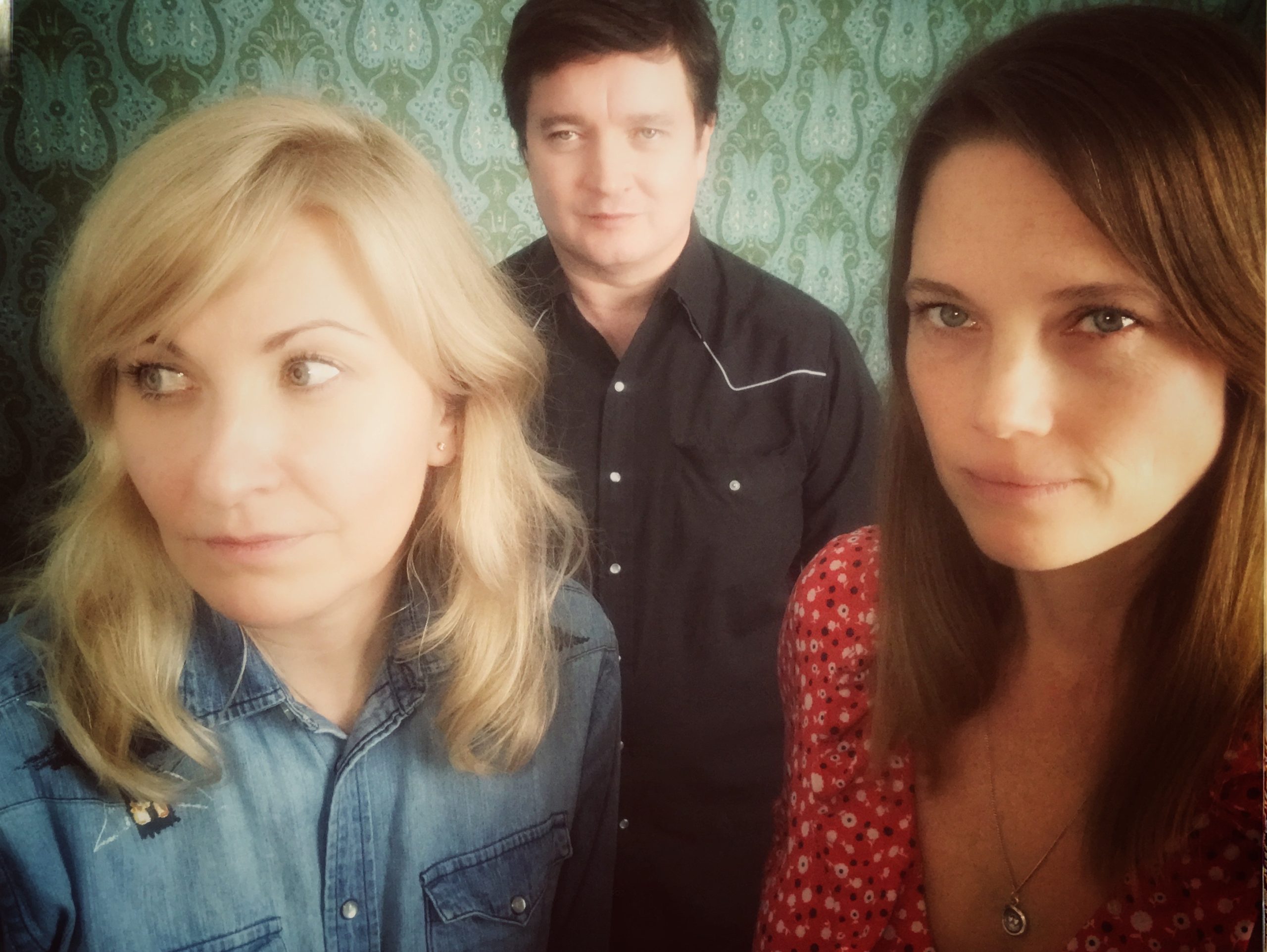
Red Sky July is the new project from three well-respected and lauded musicians. Consisting of husband and wife duo Ally McErlaine and Shelly Poole, and singer Charity Hair, Red Sky July is an entirely original debut album from a group with a phenomenal pedigree, all of whom have been steeped in music for as long as they can remember. With her sister Karen, Shelly Poole was one half of the million-selling duo Alisha’s Attic. The daughter of famed ‘60s artist Brian Poole, music was always around Shelly as a young child and she learned to read and compose music at a very early age. Since the band’s split in 2003 Shelly has gone on to become a successful songwriter for other artists, as well as releasing a solo album ‘Hard Time For The Dreamer.’
Ally McErlaine has had a guitar in his hand for most of his adult life. Sitting in his bedroom as a teenager and teaching himself how to play along to his favourite records, Ally joined Texas when he was just 17. He has been touring with them since 1988, selling over 15 million albums worldwide in the process. Ally and Shelly married in 2001.
Charity Hair hails from the small town of Plant City in Florida, and developed a love for playing music after being given a violin by her grandmother at the age of 8. Scouted by a modelling agency at the age of 18, Charity soon moved to London and ended up forming The Alice Band with two other girls she had met. It was during this time she first met Ally while performing on a TV show at the same time as Texas. Later she would become singer for The Ailerons, performing alongside drummer Dave Rowntree (Blur) – who had signed Shelly to his record label. Charity has previously performed at several of Shelly’s solo gigs, and the three have all kept in touch over the years, always wanting to work together but never quite finding the right moment or material until now.
Red Sky July came together to make music they love with no boundaries and expectations. It was set to be a 'soulfood' side project that would bring a few low key gigs and be a great contrast to their song writing day jobs. One day a week soon became five, and a group of songs with a hazy, folk-inflected sound soon found their way into shaping and becoming a whole album. The three of them then took these songs to Jazz Summers and Tim Parry at Big Life Management. With a roster of artists that includes Snow Patrol and The Verve, Summer and Parry were impressed and enlisted Rory Carlile to produce the entire album.
Yet there was a two-year break where the entire project was put on standby – Ally suffered a major brain aneurysm and was in a critical state for over a year. Finally reconvening last summer and drafting in new band member Mark Neary, Red Sky July were ready to resume where they left off. Relocating to Bristol, they recorded the album live to capture the sense of danger and fragility that playing together in the same room at the same time brings.
Red Sky July is an astonishingly assured debut album, born out of the pleasure and satisfaction of three like-minded souls creating exactly the music they hear in their heads. That such a project can touch universally only testifies to their creative spirit and abilities.  From: http://www.proper-records.co.uk/artists/red-sky-july/

Marillion - Lavender Blue


"Lavender" is a song by the British neo-prog band Marillion. It was released as the second single from their 1985 UK number one concept album Misplaced Childhood. The follow-up to the UK number two hit "Kayleigh", the song was their second Top Five UK hit. As with all Marillion albums and singles between 1982 and 1988, the cover art was created by Mark Wilkinson.
The song features a number of verses that are reminiscent of the folk song "Lavender's Blue". The song forms part of the concept of the Misplaced Childhood album. Like "Kayleigh" it is a love song, but whereas "Kayleigh" was about the failure of an adult relationship, "Lavender" recalls the innocence of childhood; The childhood theme also brought up the idea of utilising an old children's song and "Lavender" was an obvious contender as one of the original pop songs of its time. The opening lines "I was walking in the park dreaming of a spark, when I heard the sprinklers whisper, shimmer in the haze of summer lawns" deliberately recall the title track of Joni Mitchell's album The Hissing of Summer Lawns.
Unusually for a rock song from the mid-1980s, "Lavender" features a traditional grand piano rather than an electronic keyboard or electric piano. In the music video, keyboardist Mark Kelly is seen playing a Bechstein but the original sleeve notes of the Misplaced Childhood album state that a Bösendorfer was used for the recording.
On the album Misplaced Childhood, "Lavender" is a short track of barely two and a half minutes, forming part of a longer suite that continues into the likewise multi-portioned track "Bitter Suite", which repeats Lavender's musical motif at the end. In order to be suitable for a single release, the track therefore needed to be re-arranged and extended. As a result, the 7" version is significantly longer than the album version (3:40 as opposed to 2:27), whereas the 12" version – entitled "Lavender Blue" – is 4:18.  From: https://en.wikipedia.org/wiki/Lavender_(Marillion_song)  

June Rich - Wait It's U


WXPN will welcome June Rich to the Ardmore Music Hall on June 20th. The folk rock band was integral in the local music scene of the nineties, releasing two records and performing at the opening night of the Electric Factory in 1996.
The band’s list of accolades continued with a Philadelphia Magazine Best Band in Philadelphia award, a Folk Fest main stage slot (the only local band to fill that position in 1996), a performance on Mountain Stage and numerous other festival appearances. In anticipation of this reunion, which marks the 20th anniversary of their self-titled debut LP, bassist Garry Lee, singer/guitarist Vanida Gail and guitarist Allen James looked back on the beginning of their career:
“Back in 1994-95, there was a burgeoning music scene that was centered around Manayunk and specifically the Grape Street Pub,” said Lee. “It was the center for a lot of up-and-coming singer-songwriters and for bands at the time.”
“Who can really say why anything catches fire? I have no idea,” added Gail. “I just know we were having a blast onstage, just singing together. The band was sounding great. We were all just having fun and maybe the audience felt that.” As for the idea of reuniting, James said “I’m totally looking forward to it” and added, “as far as I understand, there are going to be a couple of new tunes and it’s always good to have something new.”  From: https://xpn.org/2015/04/28/june-rich-reunion/

Crypt Trip - To Be Whole


For some in the music world, the sixties never really ended and this is especially true with Crypt Trip’s Haze Country. Both a throwback and refreshing, Haze Country (Heavy Psych Sounds) lets us sit back and relive the good old days of psychedelics, marijuana and hippie Shenanigans. Even from the album cover: the aesthetic and nostalgic tinged photograph of the band mounted on motorbikes, it really does feel like this record was lost in time and it’s only just been rediscovered in your Dad’s cupboard of old LPs.
What separates Crypt Trip from other nostalgia-tinged acts such as Greta Van Fleet is that Crypt Trip aren’t purely imitating past successful acts and hoping it sells today due to the listening publics forgetfulness of musical history: everything on Haze Country is genuine and, although clearly influenced by that era, it’s not a rip off by any stretch of the imagination.
With long sixties improvisational-inspired instrumental passages, timeless-sounding riffs, gruff raw vocals and genuine musicality, Crypt Trip are the real deal. Combining Southern Rock characteristics with a psychedelic-infused mentality, songs like ‘Hard Times’, ‘Free Rain’ and ‘Wordshot’, Haze Country balances between being Lynyrd Skynyrd and The Beatles at the same time which a dream-like combination especially when put together in such a unique package.
’16 Ounce Blues’ and ‘Pastures’ sound like they should be playing in an old western saloon perched in the middle of the desert as the sun slowly sets on the barren plains surrounding them. It’s idyllic, to say the least, and the band’s time machine is fully captivating especially within these two songs.
So, if you find yourself in an open top car in the middle of southern USA and you’re looking to have a soundtrack to your escape from your small town, let Crypt Trip’s Haze Country jump in the wagon, drive for hours and never look back.  From: https://ghostcultmag.com/album-review-crypt-trip-haze-country-heavy-psych-sounds/