Thursday, October 24, 2024

Meat Puppets - Scum


The Phoenix, Arizona trio Meat Puppets made a career out of defying expectations. The two Kirkwood brothers, Curt (guitar/vocals) and Cris (bass/vocals), along with drummer Derrick Bostrom, made their debut with In a Car, a locally released 7-inch — five songs in five minutes — of shrieking thrash-punk and unrealized avant-guitar ambitions. The Puppets’ first album (a full-length disc that spins at 45 rpm) similarly mixes intriguing instrumental experimentation and a bit of restrained country into sloppy blurs of noisy punk.
Meat Puppets II marked the first of many shifts — into radical country-punk. The album offers a startlingly strong set of stylistic contrasts — loud and soft, fast and slow — all supporting moving, poetic lyrics. The songs are melodic and memorable; Curt’s high’n’lonesome singing is made even more effective by its uninhibited shoddiness. One of the best albums ever to blend Joe Strummer with Hank Williams, Meat Puppets II avoids cliches of any sort in its brilliant evocation of the wide open world of the Southwest. Make no mistake — this is not a hardcore album with some corny twang, it’s a fully realized work in a unique hybrid style.
Up on the Sun removes the Puppets further from punk, but doesn’t adequately replace the rock’n’roll energy. Curt’s growing mastery of delicate guitar weaves — an Arizona answer to Jerry Garcia, perhaps — provides the Puppets’ new focus; the hoedown coda of “Enchanted Pork Fist” owes as much to modern jazz as cowboy rock. The title track is a lovely, contemplative folk song with an airy vocal and a skipping guitar riff that repeats throughout. In a lighter moment, Curt and Cris whistle their way through “Maiden’s Milk”; waxing serious, “Creator” offers a poetic contemplation on god and nature. The Puppets sound far more involved and enthused on the superior six-track Out My Way, again quite unlike anything in their prior repertoire. An utterly crazed raveup of “Good Golly Miss Molly” merely caps off a diverse collection of occasionally funky, occasionally psychedelic, occasionally countryfied rock tunes.
Mirage harks back to the sonic translucence of Up on the Sun, forcing Bostrom’s muscular drumming to find a way to maintain its reserve while kicking up a subtle storm. Curt’s intricate finger-picking and plectrum work leads the relaxed stroll on “Mirage,” “Leaves,” “Get on Down” and “I Am a Machine.” The bluegrass-styled “Confusion Fog” shows a different side of the Pups, as does the rocking “Liquefied,” an incongruous souvenir of the band’s early sound with acid-trip lyrics and distorted rhythm guitar. The only discordant ingredient on this technically accomplished record is Curt’s uncertain, often cringeably tuneless singing.
As legend has it, the genesis of Huevos began with a magazine interview in which Curt announced his adoration of ZZ Top guitarist Billy Gibbons. Gibbons’ reply sent Kirkwood into a writing frenzy, and the album — which begins with the Top soundalike “Paradise” — was recorded in one marathon 72-hour stretch. The mildly commercialized sound (rhythm guitar, sweet melodies and a thick Les Paul tone) led hardline fans to call it a sellout, but that’s hardly the case. In this generally upbeat outing, the only discouraging words can be heard in “Dry Rain” and the self-deprecating “I Can’t Be Counted On.” Otherwise, Curt celebrates “Fruit,” “Sexy Music” and even “Bad Love.” Except for the out-there-with-the-cacti vocals, Huevos is quite fine.
Saving most of his liquid lead runs for showy instrumental passages, Curt again plays a lot of rhythm guitar on Monsters, a heavier, more tradition-minded rock album than usual. Beyond “Attacked by Monsters,” however, the colorless and repetitive songs aren’t very appealing, and the sound — which alternates between the band’s late-’80s clarity and a murky sonic swamp — doesn’t do much for them. (Ironically, the vocals here are fairly presentable.) Not among the Puppets’ best. Their eccentricities notwithstanding, the Meat Puppets were arguably the most major-label-ready act on the SST roster when they signed to the London label. The generously endowed No Strings Attached recapitulates the Meat Puppets’ career to date with two dozen chronological selections, from the 1981 EP debut through Monsters.
Forbidden Places is an unfortunate big-league debut, a surprising misreading of the group’s strengths — the earthy introspection underscoring even their most twisted songwriting; their fluid power-trio drive — by producer Pete Anderson. Best known for the downhome cool of his work with Dwight Yoakam, Anderson focuses too much on the backporch promise of Curt’s acid-cowboy whine and sands down the band’s rowdy charm to an over-fine crust. There’s a heavy streak of trippy paranoia in Curt’s lyrics — like the attack of the “little red tongues” and “fat ripe rats” in “Open Wide” — but the guitar twang is too clean, the distortion too polite to suggest menace or fear.
Forbidden Places is actually a double bummer, a so-so record that arrived just as grunge-mania broke wide open. A new generation of ruffian bands, many of them raised on the Puppets’ SST classics, raced past them into the charts. Then, in late ’93, Kurt Cobain invited the Kirkwoods to join him on camera for three Puppets songs (all from the Pups’ second LP) performed during Nirvana’s MTV Unplugged appearance. It was an impressive gesture of artistic respect and punk-rock fraternity which did wonders for the Meat Puppets’ mainstream profile. “Oh, Me,” “Plateau” and “Lake of Fire” became highlights of Nirvana’s resulting acoustic album, particularly “Lake of Fire,” which Cobain sings with a vivid, desperate ache in his voice that now sounds eerily prophetic.
Cobain also lent his name to Too High to Die, contributing a celebrity quote (“I owe so much to them”) stickered on the cover. More importantly, Too High to Die benefits from the surprisingly commercial touch of the Butthole Surfers’ Paul Leary, who co-produced it. Without muting the prairie pothead quality of the band’s sound or Curt Kirkwood’s free-associative imagery, Leary and the Puppets establish a warm, cohesive feel even between strange bedfellows like “Never to Be Found” (tangled hyper-strum), “We Don’t Exist” (hooky speed pop) and “Severed Goddess Hand” (an almost R.E.M.-ish hymn, despite the weirdo title). “Backwater” actually became a hit, a post-modern take on ’70s Dixie rock (its coltish kick bears a disarming resemblance to Lynyrd Skynyrd’s “Sweet Home Alabama”) with a feisty guitar sound that belies the blood and ennui in the lyrics.
No Joke! is made of even darker stuff, a mixed litany of comic bad-trip metaphors and outright nihilism produced by Leary and the Puppets with grim potency. (In the case of “Head,” all it takes is piano, cello and tense electric jangle.) There’s a brutish, heavy metal quality to the guitar fuzz deployed on most of the songs: the gambit practically dares you to hang in there for the good hooks carried by the Kirkwoods’ distinctive vocal drone. That may have accounted for the record’s dim chart showing, and the Puppets’ return to cult status on their way to dissolution.  From: https://trouserpress.com/reviews/meat-puppets/


Light in Babylon - Ya Sahra


It’s probably safe to say Turkey’s culture has its roots in Istanbul. And if you’re looking for world music to listen to and some of the most incredible and eclectic rich sounds imaginable, don’t look any further than Light in Babylon. This is a music group whose origins were made on the streets of Istanbul. Singer and lyricist Michal Elia Kamal, Metehan Cifici on the santour, and guitarist julien Demarque make up the core of Light in Babylon, who met in Istanbul in 2010. They toiled away in one of Istanbul’s most popular districts honing their craft and establishing their unique multicultural sound. By 2013, they recorded their first album Life Sometimes Doesn’t Give You Space and followed it up with their sophomore release Yeni Dunya in 2016. Importantly throughout this whole period, modest success followed and today the band along with the support of percussionist Stuart Dickson and bassist Jack Butler, tour across Europe, bringing smiles to the faces of new audiences everywhere. Recently, I had the pleasure to contact Light in Babylon’s spiritual leader, Michal Elia Kamel. Her story alone is fascinating, an Israeli from Iranian origin, with a wonderful positive outlook on life. But while one day I would dearly love to talk to Michal about her interesting life, for now I am very much interested by her creative musical adventure. Here is some of what we talked about.

I read that you were once described as ‘ambassadors of peace’. How do compliments like that sit with you?

To be called ‘ambassadors of peace’ it is indeed a big compliment for us, I believe it is even describing one of the reason we do music and the way we observe people and the world. We have fans from all kind of countries, from different religions and cultures, many time people are asking us, how is it even possible..?  But for us it is very clear, we always call our music world music, we see our-self as the people of the world, and our message is that before all nationally, culture, religion, language. We are all first of all humans, when we will remember that we will remember to respect each other.

Your first stage as, described by you, was the street, busking to the eclectic masses of Istanbul. It’s quite an apprenticeship to have started with. What do you recall most about those early days? Do you have any fond memories?

We performed in Istiklal street in our first years as a band, I must say that Istiklal street is not just a street, not like any street but a very special place. In that time (2012) it was a place where people who passed by there were searching for something. Something to happen, some music or art. It was a place of diversity, different people, different cultures, religions, and opinions, all passing there and listening to our music and feeling something.  The reaction of the people was amazing, they wanted to get close, they cry, or smile, or dance. To put something like our music in the middle of someone’s day, just like that, live with no boundaries, create a strong impact and touch deeply the listeners, but not only them, also us, we learn a lot from it, how to understand people, how to respect people, and how to be modest and humble, now that we become more famous and we play in all kind of big stages. We still remember what we learned from our time in Istiklal street.

Do you still love playing for passersby in Istanbul?

Of course we do not play anymore in Istiklal (or any) street, we did it for some time and it gave us so much but since then we moved forward to the next step. Just passing by Istiklal street today takes lots of attention from peoples who ask photos (which we always happy to meet). Having a performance there will be a mess and also in general many things changes in this place since our time performing there, we were hoping to inspire new young groups to continue this culture and go out there and share their music.

What is the mood like when you play at International festivals across Europe? Are people still quite welcoming?

Yes! We must say that we feel ourselves very lucky to have such an amazing people listening to our music. After each of our concerts we always give time and invite the audience to meet us for some photos, signatures and cd’s and it gives us the time to see our audience in the eyes, even if it is crowded and takes long time, we always stay till the last person because for me it is the best part of the concert. It gives me lots of hope to meet so many people with open heart and open mind, people who still believe in people and have hope and spark in the eyes like me. It doesn’t matter if it’s in Europe or in other place, people who listen to our music always react the same and the warm part of them comes out.

What is it about your music that people find so infectious?

We believe that music is not only entertainment, not only for pass the time, music has a meaning and impact on our life. Light in Babylon brings not only music but also emotion, in a world where peoples need more and more to hide their emotion, where television become more cynical and the pop music more artificial. People are hungry for something real, they want not only to hear music but also to feel it! The music we make say something, there is something honest in it, full of hope.

Listening to your music has made me realise how much I have come to appreciate music from around the world. What I’d like to know Michal is who influenced you and why did you choose to make your ‘brand’ of music?

Many things influenced me, not necessary one specific type of music but a mix of music, cultures and ideas. I grow up in a home that women power is something very important and I think you can feel this in my way of singing and voice. I come from a Persian home (both of my parent were born and grow up in Iran) so the culture and the music from home affected me as well. Our band was formed in Istanbul, Istanbul is a very special place for us, and always will be, it is a city with a lot of intense feelings, there is something old with something new, some sadness with a beauty within, some joy with energy and people and lots of movement, in a way, we can describe our music like we just described Istanbul.

You once said that although your band is made up of different members from different regions, who all speak different languages, the thing that unites you all is your shared existence and love of music. That’s quite beautiful and poetic. What else can we all learn about music and its universal appeal?

Yes, music can do many thing and can connect many people but I believe that music carries within some energy and it is very important where the music come from, for what purpose. When you open the radio and hear a commercial there is also music in the commercial, it can be very nice music, but the purpose of that one is to manipulate you to buy something. When we all met each other in the band, music connected us all but for this to be happening we had to have something clean inside, something naïve, we needed to want to be connected and to communicate. Only because of it we could create something like our music that will help others connect and feel too.

Your music covers a range of issues, which include love, loss, life and death, and in some sense existential themes. The world we live in today has undoubtedly shaped who you are. Is that a fair assessment?

Yes, our music reflect the way we see the world and the way we change with the world according to the places and the people we meet, and according to the thing that happened in our lives and our dreams. We always say we are a dreamers (we even did our own version for the song “Imagine” by John Lennon), in our music there are many messages but we are not telling people what to do or how to live but we are sharing our own story and dreams and we let them to travel among many people far beyond us. For example, I am Israeli, I write my songs mostly in Hebrew. I have an Israeli passport so there are many countries I am not allowed to enter (Tunisia, Bangladesh, Iran, Lebanon, Syria, Malaysia, Saudi Arabia and more.) my physical body cannot be there, but my voice… my voice fly far away to every place, people listening to our music and writing me from many country I cannot visit, writing me how much power it gave them, that our music helped them to come through difficult time, or helped them to understand many things. Music can travel, music has no borders.

I’d imagine your working relationship with Metehan and Julien is incredibly rewarding. Can you tell me something surprising about your strong bond?

To have your music in a way it is like to have a child, and the people you make music with are the people who are raising with you this child so they must be like your family. I, Julien and Mete started this band we know today as Light in Babylon and on our way, joined us Jack Bulter the bassist and Stuart Dickson the percussionist. We all lived and met in Beyoglu district in Istanbul, around the area of Taksim square and Istiklal Avenue, we all know thus places very well to its music scene, it was our main “playground”. In a way I feel that these guys can understand me, I feel like they are the guys from my neighborhood. Honestly I can say that each and every one of them is a great man. Some men feeling threatened by powerful women or it is hard for them to contain this kind of energy in music but I am feeling very lucky to make music with not only very good musicians but also very good and supportive humans.

I’d love to end on a final note and talk about your amazing song ‘Kipur’ and that incredible video shot in Cappadocia. Firstly, I’d like to say Cappadocia to me is quite a spiritual place. My interest in it stems from not only its geographical beauty but with the people that lived in its rocky outcrops and caves throughout history. Michal, can you tell me how you came to shot the video in Cappadocia? And what can you tell me about Kipur and its message?

I had the idea to have the video clip for “Kipur” song in Cappadocia already few years in my mind, I was waiting for the right moment and the right opportunity. Kipur is a very special and spiritual song. The lyrics are from a poem by Solomon Ibn Gabirol, a philosopher from the 11th century, Spain. The poem is about freedom, spiritual freedom, the ability to understand the nothing and the everything in the universe and within. Cappadocia gives me this feeling, special feeling of something free, but something very settled like those big pointy rocks. 

From: https://the-rearview-mirror.com/2018/03/07/music-can-travel-music-has-no-borders-interview-with-michal-elia-kamal-of-light-in-babylon/

Lamp of the Universe - Return as Light


Sitar-emulating guitars and snippets of mellotronic violins lead up to the hazy vocal lines of Return As Light, the first song of the new Lamp Of The Universe album The Akashic Field. New Zealand native Craig Williamson has once again taken a dive into an ocean filled with kaleidoscopic transcendentalism, and this is what he came up with. I thought about how cool it was that we came into contact, just shortly after he was recommended to me by Scott Dr. Space Heller in his interview on this very blog. He felt Williamson with his bands Datura, Arc Of Ascent and Lamp Of The Universe was a kindred spirit and wished to meet him some time. On The Akashic Field it is demonstrated where those warm feelings stem from.
The music is a mixture of classic 60s psychedelic rock, intertwined with Middle Eastern folk elements, and extremely dreamy multi-vocal patterns. Further on the album sometimes his spaceship takes flight into heavier, fuzzier, space rock territory. It is music made for mind traveling, and meant to take the listener on a magic carpet ride over multi-colored dunes, acidic green oceans, and through wondrous caverns and glowing riverbeds. It is such a satisfying flight, tailor made for headphone heads, with lots of nooks and crannies to explore by ear for days to come. Spending the Corona years in New Zealand, Craig Williamson wasn’t too much affected in his daily routines. I talked with him about this and the new record, and luckily he was willing to shed some light on all of that and more…

How have you been in these pandemic times? How has life been in New Zealand for a musician?


For me musically, it hasn’t changed anything. Obviously there has been a few disruptions with work and what not, and life in NZ isn’t quite the same as it used to be yet, but its getting there… fortunately we haven’t been too effected like the rest of the world.

Can you explain what living in New Zealand has meant for your music? What was beneficial, what less so?


It’s hard to say, as I haven’t lived anywhere else and it’s all I know. But from visiting other countries I feel the amount of extra space we have here gives you a different perception, and that seems to help quite a bit. There are downsides to being so far away from bigger scenes, but its something that is known, and worked around, so isn’t so bad I guess.


Can you sketch your career so far for our readers? What are some of the absolute highlights?


My career started in 1999, as Lamp of the Universe…and has slowly expanded in many different ways. I’m about to release my 13th full length album next month (January 2022) and am still excited by the new music I’m hearing from others too. Highlights would be releasing the first Lamp of the Universe album “The Cosmic Union”, hearing about artists I look up to say they’ve heard about me or have said they like my stuff. To be honest all the positive reactions from everyone to what I do is a highlight for me.


Can you tell us about the way the new album came into being? How was it written and what did you set out to achieve?


I always write for myself first, and I’m continually writing. But this time around I wanted it to be more energetic, more band sounding, so I think that’s how it’s going to be perceived. I wanted to achieve a bigger sound too, improve the overall vibe by making everything a bit more clear and full.


When are you satisfied with your music? Is there a certain formula for a Lamp Of The Universe song?


There’s no real formula, I just go by what feels right. It’s hard to say when I’m actually satisfied with each track, because you could go on adding things forever, but usually just when it just feels and sounds as close as I can get it to how I hear it in my head.


What music are you listening to these days? Are you more of an oldies guy or do you still like to explore new artists?


I like to explore, constantly. I still love the “oldies” too though. My latest things I’ve been listening to would be Aphex Twin, Radiohead, Electric Wizard, Naz, Mastodon, Adam Geoffrey-Cole, Miles Davis, Napalm Death, Pete Namlook, Klaus Schulze, Archgoat, Laszlo Hortobagyi.


Can you tell me about the lyrical concept of The Akashic Field?


It changes from song to song so there’s no concept as such. The Akashic Field as a title though could basically be seen as a receiving of all influences, an accepting of all information I can process to create a new album from influences that I’ve experienced over many years.


If you could curate your dream band, who would be in it and why?


I certainly wouldn’t play!!! I’d just watch in amazement!!!! The band would be Miles Davis, Jimi Hendrix, Paul McCartney, Klaus Schulze, Ravi Shankar and Ringo Starr.


What does the word psychedelic mean to you in the fullest sense of the word?


It means freedom to do what you want musically… to drift into the worlds beyond and back again.


What are you doing after this interview? What would you like our readers to do?


After this interview? Probably have dinner and then, like I usually do, work on new music into the night, and listen to LPs. The readers can do as they please, just be nice to each other!

From: https://weirdoshrine.wordpress.com/2021/12/14/lamp-of-the-universe-the-akashic-field-review-qa-2022-headspin-records/


La Femme - Sphynx


Sacha Got, guitarist of La Femme, appears over Zoom from his home in Biarritz, France, the low-key seaside resort town known for its vibrant surfing scene, and where Got met Marlon Magnée, the band’s keyboardist and vocalist, in secondary school. Got is almost unrecognizable to me as he’s dressed in a simple olive green T-shirt—a far cry from the glitzy, eclectic costumes the band wears in videos and concerts. “I don’t know if you remember, but in 2000, there was so many bands just playing on the roof with a T-shirt and jeans, you know?” says Magnée in a heavy French accent, joining in a few minutes later from the band’s studio. “When we arrived in 2010, we were a bit against this normalization of, like, the look…it was too much boring. That’s why we wanted to be, like, extra maximal…and, like, propose a whole universe, like cool hair, cool clothes—cooler direction, you know?”
When the two friends formed La Femme 14 years ago, they dedicated themselves to refining a sound blending soul, disco, electro, and rap. They moved to Paris and played bars and small clubs while working in the restaurant industry. After meeting some pro surfers from California who loved their music and encouraged them to come to the U.S., the pair booked gigs at a few small clubs in L.A., doing their own PR and building a small but loyal following. Then France’s music industry started to take notice. “I think the fact that in France, people saw us doing this, they thought, ‘What is this band doing in U.S.?,’” says Got. “We just released the first EP, and then we had some hype… American blogs talking about us. It’s like the power of the American dream, I guess.”
La Femme’s DIY spirit, glitzy visual aesthetic, and retro style  has won them multiple gold records and Album Révélation of the Year at the French Victoires de la Musique awards. La Femme’s second single “Clover Paradise,” is a rollicking, ‘80s-inspired synth-pop anthem about the dangers of excess, and a bold preview of the group’s upcoming sixth studio album, Rock Machine, due out October 11.

What’s the meaning behind “Clover Paradise”?

MARLON:  The idea was to do like a shuffle rhythm, you know? I love this kind of rhythm with a big snare, ‘80s vibe. And I wanted to do a track like this. And after, I don’t know why, I had the idea of “Clover Paradise” in my head, and then I wrote about when people went too deep into drugs or too deep into spiritual things, and they can lose themselves because they are looking for the truth or other things. It’s a bit like a warning song…everyone can do their interpretation.

It reminds me of the dangers of going too far in one direction or the other ideologically.

MARLON: It’s very interesting, like thinking that it’s the truth and, at the end, being blind, you know? it’s true with communism—it’s a very good ideology, but people will go too deep and you become fascist or totalitarian.

“Clover Paradise” has some pretty solid guitar work.

MARLON: We called a guitarist from California called Josh Landau. He has a project called Stolen Nova. And he is basically a big shredder guitarist. He used to have a band called the Shrine. And it was really cool to bring back this kind of shredding guitar solo because we didn’t really see that kind of stuff in any record except like metal or art rock. So I think it’s really cool to bring back this kind of stuff because we all need more heat and more rock ‘n’ roll. And the same for the sax. In this song it was really hard to cut because the guitar solo is so good, and even the sax solo. So at the end I was like, we’re just going to put four minutes of solo in the whole song. So I think this is really dope because, at the end, you get transported by the music. It fits good in the song, and we really enjoy it. And for the sax player, he’s Patrick Bourgoin, a very, very famous sax player, and he did basically all the big records of the ‘80s and ‘70s. On this song, it works so well. The sax… it’s like, whoa, you want more sax?

SACHA: Yeah, sometimes it takes time to enjoy some stuff. You need to be more mature, maybe to enjoy some sax and shit, you know?

You’ve done five albums in 14 years, all in French. This is your first all-English record. Why now?

MARLON: Well, in the last album we have a few songs in English. But basically by touring the world for 15 years—we went to L.A. the first time 15 years ago, and we had American girlfriends and stuff—we wrote so many English songs because sometimes when you write the song, it’s just the first word that comes to your mind. Is it going to be French or English? For example, “Clover Paradise,” this song came out in English in my spirit, you know? And I think it’s a good moment because now we are old enough—even if we have bad accents—we speak well. We can write good lyrics, and we can talk and have deep conversations in English.

This album has a heavy synth-pop feel to it. What are your musical influences?

MARLON:  Velvet Underground. And also the Sex Pistols. But we also like the Brian Jonestown Massacre. And also we listen to a lot of French Cold Wave and French yeyé.

SACHA:  We also like the guitar song also—this kind of music and energy with reverb. We’ve got a Dick Dale sound too.

MARLON: You have some disco also in this album.

SACHA: Yeah, it’s a great album.

From: https://www.spin.com/2024/09/la-femme-interview/


Dedsa - Annihilation


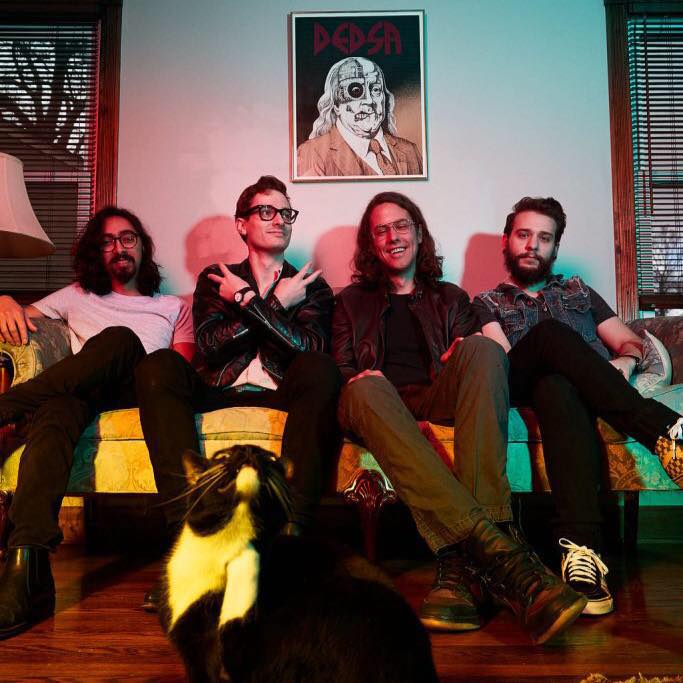
Nashville psych-rock band Dedsa are on the come-up. Made up of guitarist/vocalist Stephen DeWitt, keyboardist Robbie Ward, bassist/keyboardist Ben Carreon, and drummer Grant Bramlett, the band works together to fuse psychedelic vibes with catchy riffs and hard rock sensibilities. Before their concert at the Mercy Lounge on March 2nd, Dedsa sat down with the Vanderbilt Hustler to talk about their new album Salmon Velocity, out now.

Vanderbilt Hustler: So are all of you from Nashville?

DEDSA: Actually none of us are. Grant and Stephen are both from Birmingham, and Rob and Ben are both from Colorado.

VH: So then how did you meet?

DEDSA: Stephen and Rob moved up here separately just on a whim. Stephen was hanging out with a band that Rob was playing with temporarily, who ended up just ditching us and leaving just us behind, leaving us experimenting on our own. Ben joined us in roughly 2011, and Grant joined us about three years ago, which is when we really consider the true start. We were making a lot of compromises back then, just playing along with tracks on an iPhone. It’s just not quite the same as playing with a human behind a drum kit.

VH: Where did you get the name “Dedsa”?

DEDSA: It started as a joke; we can’t tell you [laughs], but it’s really just an acronym for whatever you want. We encourage everyone to make up their own. It’s graphical, symmetrical, it sounds like NASA, like a weird government organization, maybe potentially evil. It was just funny to us, and it’s the only thing that comes up when you google “Dedsa”.

VH: So tell me about Salmon Velocity.

DEDSA: We’ve had the name for years. We love naming things [laughs]. When we were working on the first album, we were writing a lot of MIDI back then, since we didn’t have a drummer. You can set the MIDI velocity in the computer and color coordinate it, so everything for that album we set to the color salmon. It was a perfect level; heavy enough, but not maxed out. We were like, “That’s what we’ll call our next album, Salmon Velocity!” And we actually did it! Rob ran with it for the album artwork, thinking about salmon spawning and swimming up river, loving that image in nature of things mindlessly following their instincts to their possible death, with a huge predator waiting for them under the waterfall.

VH: The music of Salmon Velocity is all over the place. What’s the inspiration behind that?

DEDSA: We like to be as disparate as possible while still seeming continuous. Some of the songs on the album that we dug out were more like the first album where they’re more studio creations. Songs like “CS80” and “Don’t Open the Door” were tracks we’ve had for a long time that we ended up developing. Some were born from us trying to play together, and some were even just sitting at a computer attacking it from the opposite end. Really I think it’s just because we all love so many different types of music, we’re trying to draw from as many influences as possible.

VH: Who in particular?

DEDSA: We love classical music, like the dynamics of a really great symphony or an opera. We love a lot of jazz, as well all the classic rock staples like Zeppelin and Pink Floyd, or modern electronic stuff like Crystal Castles or Daft Punk. We know where we won’t go, like we’re not about to write a country song or something, but for the most part everything is up for grabs. If we want to do something, we just do it.

VH: What do you think was the hardest part about making Salmon Velocity?

DEDSA: Self-producing can be really tricky sometimes, since we’re so emotionally close to the songs. It’s a very long process for us. There were a ton of mixes and remixes and more remixes. We do produce in our basement, so we have the luxury of being able to come back the next day to keep working. It is a curse and a blessing [laughs], but mostly a blessing.

VH: Your last release was Thrash Plastik in 2013. How do you think you’ve matured since then?

DEDSA: The number one thing is that it’s been great to write with a drummer. It’s much more dynamic, emotional, and we work faster. We’ve also all improved as players, after touring, playing, and rehearsing all the time. We also look a lot older [laughs]. On Thrash Plastik we wrote as we recorded, but this time around we were a lot more systematic when we wrote. I think we’re just more confident as songwriters. The overall theme of Salmon Velocity seems more thought out, with sort of a narrative arc to it, about a crises and self-discovery and finding a new way to live your life.

VH: Where will you be in five years?

DEDSA: We’ll probably be on Mars. There’s a lot less competition up there; this is actually our last show on earth, we’re heading to train with NASA after this. In all seriousness, hopefully we’ll be making enough money to keep supporting ourselves. We want to keep up the slow progression of bigger crowds, better pay, and some festivals for sure.

VH: What would you be doing if the music didn’t work out?

DEDSA: We’d definitely be dead [laughs]. Though Rob would probably still be doing illustrations. But if it all fails we have suicide pact. Or maybe we’d go be hermits, and live in the mountains. We’d go crazy!

From: https://vanderbilthustler.com/2017/03/13/qa-the-hustler-interviews-dedsa-to-discuss-their-new-album-the-creative-process-and-living-on-mars/


Gaupa - Ra


The Swedish Heavy Rock band Gaupa have recently released their second studio album entitled Myriad. The band’s singer Emma Näslund took the time to talk with Metal Express Radio about their new album, their upcoming tour with Uncle Acid & The Deadbeats, her favorite artists on Nuclear Blast Records, and more.

Metal Express Radio: Gaupa recently released their second album entitled Myriad on November 18th, what can you tell fans about the band’s new album?

Näslund: It’s a banger! A substantial dosage of the Gaupa universe. Lots of energy, swag and some softer tunes. All in all a good trip I would say.

MER: How was the writing and recording process having this being the band’s second album?

Näslund: It was good, thank you. We started writing new songs about the time we released our first full length album Feberdröm. All 5 of us are deeply involved in the writing process and this time we did a pre-production. We also produce the songs while writing. For me it was the first time I entered the studio and had all the lyrics done.

MER: What are some changes you’ve noticed within the band since the release of your first album?

Näslund: We have tried different ways to work with the administration of being a band and over time we’ve become more like a well oiled machine. When we started out all info regarding everything was mashed together in one chat. We have more meetings and more obligations now as well so you could say it’s a bit more serious than when we started out. But it’s still the five of us doing what we love – writing and playing music.

MER: The band has released four different singles from the album, what kind of feedback have you received?

Näslund: Due to our signing with Nuclear Blast we now reach more people, which we are beyond grateful for. It’s still strange to us to think that someone we’ve never met have heard our music. We have gotten some great reviews of the album now as well and of course it makes us happy campers when people enjoy what we do!

MER: What do you see for plans after the album release?

Näslund: We’ll play Fuzzfestival in Stockholm in December. We will also do a streamed show. In May 2023 we’ll go out on a tour with Uncle Acid & The Deadbeats and Blood Ceremony. This is a dream come true and we are really stoked about it!

MER: Who do you hope to tour with that you haven’t yet and why?

Näslund: Elder. They’re amazing.

MER: Anywhere that you’re looking forward to playing live and why?

Näslund: Desertfest in London and Berlin. Also the Alcatraz Festival in Belgium. festivals are great overall because we get to see lots of other bands too.

MER: How is the Heavy Metal scene in Sweden?

Näslund: Heavy. Although we lack smaller venues and the concept of people spontaneously going out to see random bands in Sweden. I think the heavier bands have a harder time to break through the surface in Sweden, it’s more common to be better appreciated abroad.

MER: What are some of your favorite bands signed to Nuclear Blast?

Näslund: Hellacopters, Meshuggah and Opeth for example. But man, they’ve got a great roster at Nuclear!

MER: What are your hopes for the band’s future?

Näslund: I wish for us all to be happy people and keep having a great time creating and playing music together.

From: https://www.metalexpressradio.com/2022/11/21/emma-naslund-gaupa-for-me-it-was-the-first-time-i-entered-the-studio-and-had-all-the-lyrics-done/

The Magpie Salute - High Water


Black Crowes’ Rich Robinson on ‘Limitless’ New Band the Magpie Salute.
Around the time Rich Robinson released his last solo album, 2016’s Flux, the former Black Crowes guitarist journeyed to Applehead Studios in Woodstock, New York, to perform and record with his band in front of a live audience as part of the ongoing Woodstock Sessions. Robinson had taken part in the series once before, in 2014, and so this time he decided to try something a little different.
“I reached out to Marc Ford,” Robinson says, naming his one-time Black Crowes co-guitarist, who played on classic efforts like 1992’s The Southern Harmony and Musical Companion and 1994’s Amorica. Ford, with whom Robinson hadn’t spoken in more than a decade, said he was in. The next call Robinson made was to former Black Crowes keyboardist Eddie Harsch. “And Ed said, ‘I’m there,'” he recalls. The two joined Robinson and his band (which also includes latter-years Crowes bassist Sven Pipien), as well as various other musicians, in Woodstock, and over the course of three days laid down an assortment of covers from the likes of Delaney & Bonnie (“Comin’ Home”), Pink Floyd (“Fearless”), the Faces (“Glad and Sorry”) and Bobby Hutcherson (“Goin’ Down South”), among others, as well as extended, jammy run-throughs of Crowes nuggets like “What is Home” and the Amorica standout “Wiser Time.”
While the musicians were playing at Applehead, Robinson recalls, “I thought it was just gonna be, ‘Hey, here’s some more solo material for the band. …'” But the recordings wound up serving as the foundation for an entirely new outfit, the Magpie Salute, which will release its 10-track self-titled debut on June 9th. Today, Rolling Stone is premiering the album’s explosive opener, “Omission,” which is also the new band’s sole original composition. “Symbolically, it’s something that is just ours,” Robinson says of “Omission,” which features John Hogg, who had previously played with the guitarist in another project, Hookah Brown, on vocals. “It just was one of those things that was so organic, and it turned out great.”
The Magpie Salute is currently gearing up for a full-scale U.S. and European tour this summer. As for what people can expect to hear at these shows? That remains to be seen. “We’re going to be changing set lists every night,” Robinson says. “We’re learning about 100 songs to start with. There’ll be a lot of Crowes material, a lot of solo material, different covers, maybe new songs. It’s just something that’s going to keep growing and changing as we move along.”
This past January, the Magpie Salute made its live debut at New York’s Gramercy Theatre. Due to overwhelming ticket demand, what was initially scheduled to be one show quickly swelled to four consecutive-night sold-out performances, a fact that speaks to the intense fan base that still exists for the music Robinson made with his brother, vocalist Chris Robinson, in the Black Crowes. But given the siblings’ well-documented contentious relationship, and their seeming estrangement – at least musically – since that band called it quits for a second time in 2015, it appears that for anyone still jonesing for a Black Crowes fix, the Magpie Salute, with three former Crowes in tow (sadly, Harsch passed away on November 4th at the age of 59), is as close to it as they’re likely to get.
“Yeah, absolutely,” Robinson confirms. “This is basically it. That band won’t be together again.” On the other hand, he adds, the future looks bright for the Magpie Salute. “I’m happy to be where I am now,” Robinson says. “I think this band is great – this is an evolution, and this is where we’re heading. The potential for us is limitless.”

The Magpie Salute seemed to spring from that first call you made to your former Black Crowes bandmate Marc Ford. Why did you reach out to him specifically?

Marc and I have always had this really deep musical connection. And, you know, he was always my favorite guitar player in the Crowes. I mean, everyone who’s played in the Crowes has been great. But Marc and I have this thing that’s really deep. And so I called him. I hadn’t talked to him directly since probably ’06. But I just thought, “Well, let’s see if Marc wants to come and play.”

After Marc said yes, why was Eddie Harsch the next call you made?

I love Ed. He was a great person and we always kept in touch. And once Ed was in, we showed up to play and it was like we never left each other. The musical chemistry between the three of us is undeniable. And then you start thinking about the amount of time you spent with one another on tour. I mean, Eddie and I had spent over a decade on a bus. Marc and I, the same thing. And the three of us together. But, you know, originally Marc was more kind of brought in to the Black Crowes by Chris, my brother. So although Marc and I had this deep musical connection, a lot of times on a personal level there was kind of a line that almost had to be drawn. So I don’t feel like I was able to get to know Marc personally as much as I would have liked to.

So what happened once Marc and Eddie convened with you at Applehead?

Once we got to Woodstock and we were able to start working and playing it was, “Hey, man, let’s play these songs and see what happens.” There’s never too much planning going on. It just felt right. We had a lot of fun, it was three days and then I continued on my solo tour. But I was thinking, “How can we do this more? I love those guys and I really want to play with them more. And I love these guys that are in my band and I really want to play with them more.” So I thought about it for a couple weeks. And just through time I kind of came up with this concept for the Magpie Salute. Like, “Let’s do this and see what happens.”

The Magpie Salute is a big band. What do you find appealing about that?

There’s something that’s really cool about having a bunch of people onstage playing, but where it sounds like it’s not a bunch of people onstage playing, if that makes any sense. Like Delaney & Bonnie, one of my favorite bands. Or Joe Cocker’s Mad Dogs & Englishmen. You have these people onstage and everyone is so musically proficient that it just works. There’s a discipline there and there’s these constant moving parts, but there’s this thing and it’s amazing. And originally Marc and I were going to sing the majority of the songs, but then I was like, “Well, look, let’s bring in my friend John Hogg.” He was in a band called Moke, and then he played with me in my first non-Crowes band called Hookah Brown. He’s an amazing singer and I’m a huge fan of his. So I said, “Let’s do this. Let’s open up the Crowes catalog. Let’s play more of our songs, let’s play covers, let’s see what happens.” Not unlike when you have Phil Lesh or Bob Weir going out, doing Furthur and those types of things. The Other Ones. I was like, “This could be really cool.”

Can you talk about the music we’re hearing on The Magpie Salute?

The record came from Woodstock. All of us were there making this recording. We had two great singers, we had my whole band, and we had Marc and Ed. The only one who was missing was John Hogg. And we had all this material. Everyone loved it. Then we brought John in and he overdubbed some cool vocals and we had a Magpie record.

This was not the first recording you’ve done for Woodstock Sessions, and the final Black Crowes album, Before the Frost … Until the Freeze, was also recorded live in the studio in front of an audience. What do you like about that process?

When you play in front of people, there’s an energy there. It’s almost like a wagon wheel with the spokes. The hub is what everyone’s there for, but everyone has a different angle, a different spoke going in a different way, for being there. And everyone’s experience is different. It’s personal. It’s intimate. But there’s also a group experience. So we’re experiencing the audience, they’re experiencing us, and we’re all experiencing this music. The energy that brings is really good fuel for doing something creative. Also, the way I like to record is to go in there and just sort of wing it. Just see what happens. In the days of unlimited recording budgets, there wasn’t any urgency to that. Whereas these days I’m interested in the gut reaction. What’s the first thing you’re going to play? Because that first thing is not filtered. The first thing is going to really come more from your heart. And that’s what’s exciting to me. So we went in, it was a finite amount of time, three days, and we were done. And it was great.

How did you choose the covers to perform?

These are just ones that I’ve been playing with my band, like Bobby Hutcherson’s “Goin’ Down South.” “Fearless” was one Marc had done in the past, and I used to sing it in the Crowes. So it was a hybrid of things we had done before. Bob Marley and the Wailers’ “Time Will Tell,” we had done that on The Southern Harmony and Musical Companion, and I was like, “This could be kind of cool.” And “Wiser Time,” I really like the way John and I sing it together. So it was just about picking songs that everyone would sound good on and where we could bring different elements of what we do into it. And I think we did 70 or 80 songs at Woodstock. And we did 80 songs in New York at the Gramercy Theatre shows. Pretty much every set was different in New York. The songs on the record, I thought it’d be a cool snapshot and would show a broad spectrum of what sort of musical ground we covered in Woodstock.

From: https://www.rollingstone.com/music/music-features/black-crowes-rich-robinson-on-limitless-new-band-the-magpie-salute-119136/