Thursday, October 24, 2024

Strawbs - Tears And Pavan


Strawbs - Bursting at the Seams. Release date: Feb 1973 (ads appeared in music papers dated 10 Feb 1973 saying album released "this week"). Had been scheduled for 26 Jan 1973 but was delayed by production difficulties. With Dave Lambert replacing Tony Hooper and bringing a new rock-based dynamic to the band, the Strawbs scored an instant chart hit with "Lay Down", followed by their number 2 UK hit single, "Part Of The Union". The band courted pop success with several apearances on Top Of The Pops and flirted with the current glam-rock trend wearing make-up and flamboyant stage clothes. Letters to Melody Maker accused Strawbs of "selling out", vehemently denied by Dave Cousins.
The album, which carried on the musical journey towards rock, also reached number 2 in the UK album charts, including some all-time Strawbs classics such as "Down By The Sea", "The River", "Stormy Down" and "Tears And Pavan", as well as Dave Lambert's splendid "The Winter And The Summer" and Hud and John's "Lady Fuschia". A 52 date tour of the UK in early 1973 saw them reaching a newer, younger audience. The stage show included some comedy material - Lambert's "Bovver Blues" and a camped up impersonation of Little Jimmy Osmond by Hud - which eventually grated on Cousins, who made his feelings known in uncompromising fashion, singing the bitter "A Song For Me" at the band's April London showcase at the Rainbow. Afterwards, they embarked upon a gruelling second US tour, and the album title proved prophetic with the group splitting asunder after things came to a head in Los Angeles.  From: https://www.strawbsweb.co.uk/albtrack/bats/bats.asp

Bursting at the Seams by Strawbs: With Tony Hooper departed, and Dave Lambert on board, the last of the Strawbs traditional folk influences (excepting Cousins of course) had gone. This was the album which broke the Strawbs to the masses, containing as it did, two hit singles. "Lay down" is a good burst of Dave Cousins at his most commercial, a light but enjoyable sing along. The less said about the pop song "Part of the union" the better. It was admittedly a massive hit single, but it misrepresented what the Strawbs were all about, the band were I trust embarrassed all the way to the bank! In defense of Dave Cousins, the song was really a Hudson-Ford track, the rest of the band appearing to have little to do with it performance wise. Lyrically the track was quite satirical, taking a swipe at the power of the trade unions in the UK. It was completely misunderstood by many union activists, who adopted it as their anthem (a bit like the way Bruce Springsteen's "Born in the USA" was completely misunderstood by some).
These two tracks aside, there is a lot of excellent stuff on the album. The opening two tracks, "Flying" and "Lady Fuschia" are both melodic and well structured, "Flying" having several contrasting sections. "Down by the sea" is as close as the band came to symphonic prog, complete with an infectious chiming guitar theme, with an orchestral backing. The following track, "The river" features one of Cousins occasional divergences into "adult" themes, which he always seems to approach with schoolboy fascination, great track though. When performed live, the band always reverse the order of these tracks, the climax to "The river" giving way to the wonderful guitar theme of "Down by the sea". In doing so, the tracks effectively become a wonderful 10 minute two part piece.
"Tears and Pavan" is two distinct songs, which merge into a single piece rather beautifully. The echoed vocal refrain on the first section and mellotron backing make for a pleasantly emotional feel, while "Pavan" provides an Elizabethan harpsichord link to a slightly more upbeat latter half. Whether this line up with Lambert or the previous one with Hooper which recorded "Grave New World" (or indeed the one with Rick Wakeman which made "From the Witchwood") represents the "classic" Strawbs line up, will always be a source of debate. We should therefore satisfy ourselves with the thought that though band members came and went, the Strawbs made many classic albums.   From: https://www.progarchives.com/album.asp?id=2895

Swinging Popsicle - Joy Of Living


Swinging Popsicle was formed in 1995 when singer Mineko Fujishima and guitarist Osamu Shimada joined bassist Hironobu Hirata through a newspaper ad. The band’s first effort was the Sunny Silent Park EP. In 1998, their first self-titled full-length album Swinging Popsicle debuted from Sony Music Entertainment at Number 1 in the New Artists category, producing the hit singles “Joy of Living,” “I Love Your Smile,” and “Parade.” After extensive touring, the band returned to the studio for their second album Fennec! (2000).
After starting strong with multiple Sony-label releases, Swinging Popsicle continued to build their international fan base with their independent releases of Change and Orange. Four solid years of writing and performing live throughout Japan produced their most mature and powerful CD titled Transit (2004), featuring signature song “I Just Wanna Kiss You.” In 2005, the band embarked on their first tour to Korea.
2006 marked their United States debut at Fanime MusicFest in San Jose, CA. The same year their song “Clash” was included in a compilation CD with the Korean manga “Cracker.” Performing to regular sold-out one-man live shows in Japan, (some running as long as 3 hours) the band continued to develop new material for their full-length album Go on (2007), which featured “rainbounds,” “Clash,” and “Chocolate Soul Music.” In June 2007, they returned to America to perform at Anime Mid Atlantic in Richmond, VA, and New York Anime Festival at NYC’s Knitting Factory.
Swinging Popsicle has also contributed music to the Nitroplus PC games Star Mine Girl, Axanael, Kimi to Kanojo to Kanojo to Koi, and various songs for the Nitroplus mascot Super Sonico’s band, Daiichi Uchuu Sokudo (First Astronomical Velocity). In 2009, the band released the CD Loud Cut, collecting their soundtrack work and remastered versions of some of the member’s favorite early tracks including “Afterglow” and “Let Me Fly”.
Swinging Popsicle members have kept busy in recent years with various solo projects. Guitarist Osamu Shimada formed his own shoegaze band The Caraway and lends support to Seikama II’s Ace Shimizu Project, Face to Ace, Korean pop vocalist Taru, and popular J-Pop artist Fujii Fumiya. Vocalist Mineko Fujishima has performed backing vocals with top-selling J-Pop R&B artist Kusuo and formed the jazz-rock band alma-grafe in 2017.  From: http://resonance-mms.com/artist-profiles/swinging-popsicle/


Cold Water Flat - Swollen Sonnet


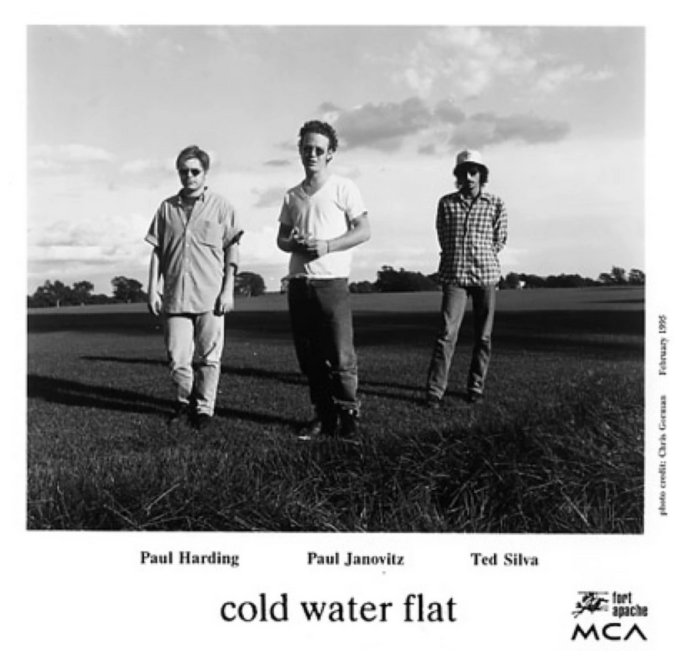
 Cold Water Flat was an alternative rock band formed in 1990 in Amherst, Massachusetts as a trio comprising Paul Janovitz (vocals, guitar), Ted Silva (bass), and Paul Harding (drums). Formed at the University of Massachusetts, they carved a niche for themselves in Boston's vibrant music scene, akin to Buffalo Tom, led by Paul's brother Bill Janovitz.
Initially, Cold Water Flat's music was rooted in the alternative rock movement of the 1990s, reflecting a blend of alternative pop/rock and indie rock influences. Their style was marked by angst-laden lyrics and gritty guitar play, typical of the era's grunge-influenced sound.

"Listen" (1993): The first album, "Listen," released in 1993, was a significant debut for the band. It saw its release in Europe under the Bitter Sweet label and in the United States under Sonic Bubblegum. The album was recorded and mixed at Fort Apache, a renowned studio in Cambridge, known for its role in the alternative rock movement. This setting provided a fitting backdrop for the band's creative process. The production of "Listen" was a collaborative effort between Paul Janovitz and Tim O'Heir, adding depth and texture to the album's sound. Contributing to the distinctiveness of the album were Bill Janovitz, who lent his skills on the slide and lead guitar, and George Lanides on guitar and acoustic bass. The visual aspects of the album, including its design and photography, were handled by John Egan and Theresa Kelliher, with additional contributions from Paul Janovitz himself.

"Cold Water Flat" (1995): Their self-titled album, "Cold Water Flat," released in 1995, continued to showcase the band's evolution in the music scene. This album was recorded at the same Fort Apache studio in Cambridge, MA, which by then had become a hallmark of quality in the alternative music space. Embracing the pop/rock genre, the album leaned towards alternative pop/rock and alternative/indie rock styles, reflecting the band's versatility and adaptability within the broader spectrum of rock music.

From: https://digmeout.substack.com/p/cold-water-flat-history-of-the-band

Messa - Rubedo


On March 11th, the Post-Metal world will and should be watching when Italy’s most elegant combination of Jazz and Post-Metal releases their third full-length onto a waiting world. Well, the VoS-lers surely can’t wait for Messa’s new record Close! And as we like to keep you on the edge of your seats we give you a detailed interview with the band conducted by our living library Knut who has gotten a lot of really good answers, mostly from singer Sara but also from her bandmates on several questions. Maybe this will make you as excited as Knut and us about this release because it is really a great release and another proof that elegance and force are not at all at opposite ends of the musical spectre but really combinable!

Congratulations on your new album! You have really developed your music further! After the two releases Belfry and Feast for Water, you now name your album Close. The cover of the first album has a picture of the famous bell tower in Lake Reschen, the cover of the second one is connected to water and now on this new one dancing women, I assume they are performing the Nakh dance from the video for the song “Pilgrim”. The covers on the previous album had clear connotations with the titles. So, what is the reasons behind the title Close that you have chosen for this new album?

The term “Close” has a lot of meanings. Actually, each of us in the band looks at it through different perspectives. We like to think that “Close” is a direct emanation of our yearning to escape. The main goal was transporting ourselves and the listener on a journey. We wanted to stand by the concept which lies behind the title of the record by creating and recording it while being physically in the same room. It is not a concept album but we always want to have that fil rouge, that thin red thread that ties the songs together, just like we did on our past albums. We came to read about Nakh once we found this 1930s picture by E. M. Schutz. The picture conveyed the sensations we wanted to express through the albums, so we decided to use that photo on the cover of Close.

So, about the dance that is a traditional dance performed by women in Algeria/Tunisia and the distinct Eastern Mediterranean musical influences on this album. At the end of the second song, the heavy, fast and doom-laden music incorporates some sonics from traditional Eastern music, and the next song start with a Duduk, also connected to the Eastern music, the instrument spread through the Eastern part of the Mediterranean all through Armenia. And you incorporate Oud and Dulcimer in the sonics. And the name of the song “Orphalese” is connected to the Lebanese poet Khalil Gibran. These Eastern musical elements are extremely well incorporated in your way of playing doom metal throughout the album. How did these inspirations find their way into your music on this album?

As previously stated, the whole idea behind Close is the journey. We did not want to repeat ourselves, so we looked for new sounds and instruments that are not typical within the metal genre. It was natural for us to search for inspiration in the musical heritage that we have as Mediterraneans. Arabian music is very evocative as it can transport the listener to a different place. Alberto had to learn how to play the Oud - which has 11 strings and is a fretless instrument, which allows you to play microtones – and it was not easy for him. Another challenge we had to face was incorporating these different acoustic instruments while keeping Close a metal album.

Let us go back in time for some background. Six years ago, I found Belfry on Bandcamp, and it happened to me as with so many others; it blew me away. I tried to find other releases by Messa but discovered the jaw dropping thing that this exquisitely performed album in fact was a debut album, full-length even. So where did you come from, musically when forming Messa in 2014? What background of musical styles were fused into what became Messa? What did each of you contribute?

We have very different musical backgrounds and they all ended up straight into Messa’s cauldron. Alberto mostly played Prog, Rocco had many Black Metal bands, Marco played in a Dark Rock band and Sara played bass in Punk/Death Metal/Grind projects. In fact Messa is the first band Sara ever sang in. We all befriended many years before Messa started, though. In early 2014 Marco and Sara started developing some ideas, and soon Alberto and Rocco joined. None of us had played Doom before and we were curious to approach a genre that sounded new to us as musicians. Our songs are the result of our sensibilities mixed together. There are many personal elements that we introduce when we create music. Some examples could be blast beats or jazzy solos.

Metal related music is not for everyone, but when one breaks the code one never leaves this kind music. What was the first album you remember that got you into metal music? What inspired you guys to compose and play metal related music?

Probably the fascination with music derives from our parents and families. All of us came in contact with more extreme metal thanks to suggestions from friends in our early teen years.

Sara: I vividly remember crate digging through my parents’ vinyls when I was a kid and being fascinated by the cover of Born Again by Sabbath.

Marco: I think for me it was Judas Priest’s album Painkiller.

Rocco: The three first metal records for me were Reign In Blood by Slayer, Arise by Sepultura and Sound Of Perseverance by Death. I was 12 at the time I made these discoveries.

Alberto: When I was like 8 or 9, just before picking up the guitar with the idea of learning how to play it, I had a small compilation (on cassette) I made myself ripping old vinyls my uncle had in the basement. The very first track was ”Gipsy” by Uriah Heep. I was obsessed with that song. I was really fascinated by the atmosphere and the sounds that guitar and organ had in it. It’s also one of the first songs I later learned to play, so I guess that was the beginning for me.

The band name Messa is connected to mass and by that has some connotation to rituals and ceremonies, just as Amenra evokes with their album names and other things. In addition, you also have this fascinating term scarlet doom to describe your music. Scarlet is an important color in the Catholic Church and as such the color is associated with religion, devotion and sacrifice. At the same time like with other red-spectrum colors it is associated with courage, passion, fire and joy. And you even have the song “Rubedo”, which is associated with redness (blood) in alchemy, and also to Jungian psychology where it represents the “self-archetype” in the archetypical schema. So, where do we place the themes and lyrics of your music in this kind of multitude of connotations?

Nothing is random in our records, we like to have a ‘fil rouge’ binding all our material together. We spend hours doing research on all the sides involved in creating a record. There are various layers of complexity in what we create, from the songs to the graphic design. Loosely quoting The Big Lebowski, we aim for the carpet that ties the room together.

When I put on a new album by Messa I always expect the unexpected perfectly performed. And once again this happened with Close. It might be the most diverse thing you have released so far. This album is composed, rehearsed and recorded during the pandemic which has affected us all. How must we envision this process during the pandemic? Do you have a main composer or is it the collective effort as you write “All songs were written and arranged by Messa”?

Thank you. We tried to play together as much as we could, but sometimes it was nearly impossible due to the situation. Some ideas for this album were developed on our own at home but we always work on songs together in the deconsecrated church we use as a rehearsal room. The songwriting is a collaborative effort 100%.

When entering the studio – how clear-cut is your vision of what will come out in the end? Do you plan any space for improvisation ahead of or during the recording process?

Let’s say we always have strong ideas already, but we like to leave some empty room for experimentation. We spend countless hours rehearsing in order to give the album a steady foundation. Some studio casualties or coincidences happen though, and often create something that unexpectedly works great.

We have to ask Sara about her vocals because they are as outstanding on this new release as on the previous releases. On this record your performance is even more versatile than on the others. When did you discover your wide vocal range and had you or have you taken lessons to develop your voice? And who is your inspirational role models when you use and develop your vocals?

Thank you very much. I never took any singing lessons to be honest, it was just trial and error. On a merely methodical aspect a central thing is the awareness of how your body works and feels. Learning how to use your diaphragm or understanding the capacity of your lungs, for example. But the primal aspect of singing is what fascinates me the most. Channeling blood and fire, allowing them to go through you… resulting in you becoming the fire itself. It’s not a matter of technique, it’s a matter of guts. This is basically how I personally experience art in general. I could never sing about stuff I don’t care about. Some of the singers that had a toll on Close are Billie Holiday, Yma Sumac, Lisa Gerrard.

Rocco, you really lay the foundations for the music. As the music is so diverse, you have to follow and it seems sometimes to lead with your drumming. It is impressive how the whole band thunders against the end of “If You Want Her to Be Taken” and the drumming just picks up pace and throws the music into a tumultuous speed punk with screams in the short “Leffotrak”. Who are your inspirational role models for developing your drumming skills?

Rocco: Thanks, I appreciate your kind words. I am inspired by so many different styles of music and drumming. The first time I heard Led Zeppelin, when I was a kid, I was shocked to hear Bonzo. He was the first inspiration and still one of my biggest ones to this day. I also really like Dave Lombardo (Slayer) and Frost (Satyricon, 1349) for playing effortlessly precise in faster music tempos. Some jazz drummers like Buddy Rich or Jojo Mayer (the latter I consider the best living drummer) also had an impact on me, especially for their fantasy. I appreciate it when drums ‘serve’ the riffs making a solid foundation for a song. One of the characteristics that I think the previously quoted drummers have in common is their creativity: they create non obvious fills that at the beginning feel odd but then turn out to be great. All of them have a drumming style that is very personal, unbiased. And Lombardo is the gold medal of metal drumming to me, but that is my personal view.

Marco and Alberto, the two guitarists, who lay out the doom Sara can soar over, and Rocco can build a foundation for, what are your sources of inspiration and musical role-models? I mean, on this album, you almost dip into every genre, jazz, classical and not at least creating the heavy melodic riffs that more than once evoke the giants of the genre.

Marco: My way of playing is based on Lemmy’s approach with Motörhead. Simple riffs, full power chords, Marshall 100 watts Plexi head with hot tubes and a big cabinet. Once this base is laid down, I mix these elements with other sounds and experimentation. I also play guitar on some songs at concerts and I use this setup with two cabinets instead.

Alberto: I have a really ‘70s approach to playing guitar. At the beginning I really thought there were no such things as pedals and effects, I really didn’t know or care about any of those little boxes. Just the guitar and the amp, all the stuff I needed were controls for tone and volume on the guitar and the amp. My heroes were (and still are) the great British rock blues guitarists, such as Jimmy Page, Eric Clapton, Rory Gallagher and so on. I pretty much learned everything by ear listening to the records. That had a huge role on developing my ability to improvise and compose. At some point I was really into Blues (Derek Trucks, Robben Ford) and Jazz (Wes Montgomery, Charlie Christian) so I studied Jazz Guitar at the Conservatory of Vicenza and got my degree. During that period I went on a vacation in southern Spain and totally fell in love with the Flamenco guitar. I think, as a guitar player, after hearing Paco De Lucia or Vicente Amigo for the first time you’re not the same person anymore. I’m still trying to figure out the nightmare (in a good way) of playing real flamenco guitar, it’s VERY hard. In the end I guess it’s all of the above and none of them at the same time. I think you really have to play what’s best for the song, and that might not include what you like the most or not playing at all.

We understand that Sara writes the lyrics for the albums. “Pilgrim” has the lines “Pilgrim/ Your breath blows away/ All my thoughts” and “Dark Horse” features the lines “I only see with my eyes closed/ You are just buying a dark horse”. Lines that let our imagination run wild with the music to support. What are the lyrical themes throughout the album? What comes first, the riffs/melody or the lyrics?

There is no main topic for the lyrics in Close, but for sure there is a whole spectrum of emotions inside of them. Guilt, sadness, anxiety… Confronting yourself and what you feel is inevitable. Regarding the order of creation we always write riffs first. Vocal lines come after, yet sometimes lyrics were created before the music was born and were adapted to fit a certain song later on. I don’t have a step-by-step procedure for writing words, they just come when and where they want. Due to this, I have pens and scraps of paper with me all the time.

Your graphical expression throughout covers, the hard copies of the albums and the videos are very elaborate. We understand that some band members have some background/education in photography, graphics and more. Do you make all your material yourselves or do you collaborate? And: Who came up with the band logo?

We care a lot about the visual outcome of Messa, we like to work on the imagery of our music and often have clear ideas on how to represent it. Marco is the one who takes care of all the art direction of the visual project regarding Messa. Marco and I then do part of the process on their own (photography, graphic design etc.) when it’s possible to do it “in house”, but we also collaborate with other professionals to bring our ideas to reality. The physical formats of Close will feature a special booklet with film pictures taken by photographer Federico Floriani. He spent hours with us in the recording studio, documenting the sessions. Another person we collaborated with since the beginning is director Laura Sans. She shot all of our videos so far, including the one for “Pilgrim”. Her help was fundamental throughout these years. The band logo was created by Marco himself back in 2014.
 
From: https://veilofsound.com/2022/03/02/Interview_with_Messa.html

Le Grand Sbam - Dins O Sbam


Another grand slam (aka grand sbam) of the year 2019, and at the same time one of fantastic, fanatical debut opuses in avant garde-progressive scene. Le Grand Sbam’s debut album "Vaisseau Monde", much-awaited by every avant garde-progressive rock fan, has been launched in the last month of 2019, and surprisingly appreciated for only a month. No more expression needed because lots of Lyon-oriented avantgarde warriors like ni., PoiL, Chromb!, and so on. And of course, massive energetic, powerful sound connotation you can hear all through this creation.
Plenty of sound approaches and technical appearances come up to your ears. The first shot "Dins O Sbam" is a killer. Sarcastic, deeply heavy, incredibly complicated melodic / rhythmic movements with female voice / shout madness should absorb your brain and inner mind without breath. Oh God. Not only guitar heaviness nor dissected percussion / drumming salad, but also Japanese shakuhachi (amazing) or quirky synthesizer dances will invade deeply in. Quite enjoyable is a chase of female voices and heavy fuzzy guitar sounds in "Kouia" ... in such a melodic confusion, you would find something methodical and methodological. Weird really.
And imho my favourite is the fourth turf "Woubit" featuring hippy spacey ghostly Kraut-y psychedelia. Reminds me like Fille Qui Mousse meet Mahogany Brain. Always feel I would drive myself deeply beneath the sea of the track. In the last one "Vishnu Foutr'line" addictive combination of beautiful lines and adherent complexity can be received here and there. But hey as their sound compilation this track can be felt, methinks. In conclusion, cannot call this creation as diverse nor colourful easily but for every avant-prog or Zeuhl fan this opus should be of much pleasure. And let me say thanks to Dur et Doux for recommending such a fine production.  From: https://www.progarchives.com/album.asp?id=64351

Bryan Scary & The Shredding Tears - Cable Through Your Heart


I have learned many interesting things about people through lively music discussion. One would be the form of desperation individuals often find themselves in, looking up random artists on Wikipedia and presenting baseless knowledge in order to impress a colleague or a romantic interest. Another would be the form of music elitism people present in order to gain some sort of fictional rank or form of self-admiration. “Have you heard the new Strokes album?” an average music fan asks. “Anyone who listens to music like that without comprehension of the genre’s history and origins is useless,” the elitist replies. “My taste in music represents the absolute (unwritten) law that all other fans should abide by.” Yeah, right. Even while the individuals who commit these acts are often harmless and easy to humor, should we really blame them for their snobbery? After all, the desire for attention is human nature. From a baby crying in a crib to an elderly man attempting to relive his past dangerously, most of us experience points in our lives where other’s impressions of us are depicted as more essential than they should be.
Placing any contemporary album in the same sentence with Sgt. Pepper’s Lonely Hearts Club Band is liable for a head-bashing from any of these so-called elitists. Yes, I wholeheartedly agree that it is arguably the greatest pop album of all-time. And of course, I also agree that no artist will ever produce another form of innovation unheard to the decade that the Beatles did with Sgt. Pepper in the 60s. However, with that in mind, I certainly do not turn red in dismay when I hear that a contemporary album has been compared to an untouchable classic. Unless someone clarifies that the new release is of better overall quality than its preceding influence, I will not bother arguing with personal opinion. Finding two people in this world with the exact same artistic taste is impossible regardless of how you look at it. So, I am going to go the full distance on this one and call Bryan Scary‘s debut album, The Shredding Tears, the Sgt. Pepper of 2006. Yes, it was released last year and, for whatever reason, has received barely any recognition. So, what makes a Sgt. Pepper, you ask? Simple. When reminiscing about the classic Beatles album, most of us think of a pop album enshrined in flawless production, irresistible melodies, conceptual themes, and melodies that render most contemporaries untouchable, containing not one song that is lacking in quality or effort. Have we heard music in the mold of Bryan Scary before? Of course we have, thousands and thousands of times before. Any fan of the Beatles, The Kinks, Queen, or Squeeze can tell you that easily. In fact, Scary’s vocals are often comparable to Brian Wilson or Glen Tilbrook, two pop artists who could easily make a successful song using their vocal harmonics alone. In fact, judging from the impeccable piano-led melodies accompanied by the charmingly inviting vocals, some may even mistake Bryan Scary for a collaboration between Tilbrook and Paul McCartney.
While it is true that Scary’s stylistic approach, both instrumentally and vocally, is comparable to a vast number of classic pop artists, this obstacle in becoming a notable innovator is merely a component that should be overlooked to get the most out of The Shredding Tears. Those who expect complete innovation in every modern release are of a foolish nature. Music is an art that has lasted thousands of years and with each passing year it becomes more difficult to push creativity to a new level without being labeled as outdated. Despite the unavoidable comparisons, the most impressive aspect about Scary that causes him to stand apart from the generic mold is, simply, his natural ability to write a memorable pop song. Apart from the drums, Scary writes, sings, and plays all the instruments in every song on The Shredding Tears. Personally, he is one of the most talented musicians I have stumbled across in the past few years. While his multi-instrumental ability is extremely impressive, it is his songwriting that shines with the most brilliance. The majority of the tracks contained on the album implement a similar approach with an emphasis on unavoidable hooks, mostly dragged on by vocal melodies and piano-laden key changes. Scary’s most attributable instrument is the piano, also the one that he has clearly mastered to the most significant degree. Incorporating a variety of electric guitars and keys is the norm throughout The Shredding Tears. Solos on both fronts are supplemented by a variety of production effects, whether it be the throwback shrill organ in “Mrs. Gracy’s Revenge!” or the contemporary usage of synths in “Misery Loves Company”. It appears safe to say that Scary is a knowledgeable student of successful pop music. He flawlessly incorporates the techniques of past artists like The Beatles and Queen into his own creative approach, resulting in an album that pushes the limits of present-day virtuosity and musical aptitude.
The Shredding Tears, as the name eludes to, is considered to be a concept album by Bryan Scary himself. He appears to be taking a cue from Mr. Bowie himself, chronicling the day-to-day life of a rising rock band, meeting fascinating characters and adopting exotic lifestyles along the way. Of course, like all concept albums, my interpretation is solely personal. If someone has the time and effort to sort out Scary’s clever remarks into one cohesive storyline, please do so in the comments below. I am just as curious as most of you. There is most likely some stunning message behind this melodiously inducing album, though it is difficult to care when wrapped up in the pure irresistibility of the songs as a whole. Scary reaches near pop perfection in both “The Ceiling On The Wall” and “The Little Engine Who Couldn’t (Think Straight)”, both representing an expressive outburst in both the verse and chorus. Typically, the casual artist saves his hooks in time for a predictably drawing chorus. Scary implements this tactic while making the verses just as engaging. The structure remains unpredictable the first few rounds through, the verses picking up pace after each bridge is presented with the usual passion and invigoration. Scary’s unconventionalism does not stop there. Oddly enough, the most impressive tracks are those that appear later on the album, with the first three tracks being the weakest on the album and lacking the quality of latter gems like “The Bottom Of The Grave” or “The Bloodclub”. However, from “The Ceiling On The Wall” onwards, this is an outstanding album. It is a shame that I found this album after I completed my top albums of ’06. It would have certainly competed for a spot in the top five.  From: https://www.obscuresound.com/2007/06/bryan-scary-and-the-shredding-tears/


Crawlers - Better If I Just Pretend


Based in Liverpool, raging rockers Crawlers have spent the last couple of years building a loyal and committed fan base, and have now shared their long awaited debut EP – a diverse collection of emotion-strewn anthems. From the raging, politically-charged energy of ‘Statues’ to the sparkling melancholic splendour of ‘Come Over (again’), each track oozes the band’s trademark impassioned drive and swirling raw charisma. We caught up with Crawlers to find out more about them and their mission as a band…

Hi Crawlers, welcome to Get In Her Ears! Can you tell us a bit about the band?

Hiya Get In Her Ears! Crawlers are a four-piece band based in North-West England (half of us from Warrington and the other Liverpool), we formed in late 2018 and like playing around with the sound of rock in any way we can, but most of all we’re four best mates who love creating music.

How did you initially all get together and start creating music?

Amy (guitarist) and Liv (bass) played together in a few bands in their high school and ended up splitting up when both went to different sixth forms. Holly (vocals) and Liv then went to LIPA Sixth Form in Liverpool, and were into very similar music and decided after dabbling in a few projects to create a band with Amy. We met Harry just after we released our third ever single as he wrote a review of the song for a magazine, and once we said we needed a new drummer he was the perfect fit!

Your new EP Crawlers is out now – can you tell us what it’s all about? Are there any themes running throughout the EP?

The EP has many themes, however it definitely has an overarching theme of struggles. The first single ‘Statues’ is about the corruption of the American police system, and its institutionalised racism. The second ‘Breathe’ is about my (Holly) existential crisis about the development of social media and technology. The penultimate ‘Monroe’ explores the beauty standards specifically for women in media, and the unfair treatment of Britney Spears. And finally ‘Come Over (again)’, the final track, is about our own personal woes, grief of relationships and family, and most of all, the people who cause such feelings.

You’ve been compared to the likes of Nova Twins and Yungblood, but who would you say are your main musical influences?

We’re very lucky to be compared to both artists as they’re both individually extremely talented! We as a band definitely are inspired by the likes of Nirvana, The Strokes, Queens of the Stone Age, Pixies and Smashing Pumpkins… However, individually we all love very different types of music which allows us to delve into many different types of genres. Holly loves artists such as Mitski, Phoebe Bridgers and Black Country New Road, whilst Liv is a huge metal fan, inspired by bands such as Metalica and Tool. Harry loves Gorillaz and Rage Against the Machine, and Amy is the biggest Fleetwood Mac and Abba fan possibly ever!  

How is your local music scene? Do you go to see lots of live music?

Liverpool is a wonderful scene currently, exploding with some of the UK’s biggest talents of many alternative genres. Everybody knows everybody and word spreads fast of a new band on the scene and it’s absolutely crazy to start becoming mutual friends with artists and bands we have loved and respected since we first started out in the scene.

And what can fans expect from your live shows?

As we have grown as artists, we have definitely also grown as performers. For some reason I (Holly) used to pretend to be badass on stage, when in reality I’m a bit of a joker. We focus on creating a safe space for all kinds of supporters, as I have sensory issues. I try to ensure when our heavier songs are played that everyone is aware of their space, as well as those around them and their actions, so that everyone can have a good time! I know there’s been a lot of times at heavier gigs when I have personally felt extremely overwhelmed because of the environment, and we wanna let people enjoy heavy music no matter how they like to enjoy it. Not gonna lie, sometimes I do treat a gig like a bit of a comedy show – I have a funny rapport with the audience and a giggle with the band. I feel like that makes it a lot more personal, and when our emotional songs are performed, it feels like we go through every single emotion at our gigs.

As we’re a new music focused site, are there any new/upcoming bands or artists you’d recommend we check out?

Our current favourites from our scene are definitely Torture and the Desert Spiders, Stone, Gadzooks and Zuzu! All you should definitely check out! Generally I would recommend Witch Fever, Vial, Lowertown, Tash and Charles and the Big Boys too.

And how do you feel the music industry is for new bands at the moment – would you say it’s difficult to get noticed?

It’s a hard one. Social media has definitely made it easier for artists to get noticed, however it has also meant major labels have even more power to control, and has meant the over saturation of artists has made it difficult to stand out. A good time to play around in the live scene, now it is all back and about, and a good time to build a platform!

Finally, what does 2022 have in store for Crawlers?

A lot. We’re going to be going on our first ever tour, and hopefully showing you guys even more of our now very diverse catalogue, hehe. We’re just so lucky for so early in our career to have such amazing supporters and fanbase – and we can’t wait to grow our craft and share it with the world!

From: https://getinherears.com/2021/12/08/introducing-interview-Crawlers/