Thursday, March 30, 2023

Polecat Creek - Lyin' Man


 #Polecat Creek #bluegrass #Americana #folk #roots country #traditional #singer-songwriter

Most old-time string bands keep their repertoire routed in the classics, learned either from recordings from the 1920s thru 1940s or old master musicians. Polecat Creek, however, offers no less than fifteen original songs on Leaving Eden. Greensboro’s Polecat Creek presents an exceptional balance of traditional country sounds with new songs penned by musical partners Kari Sickenberger and Laurelyn Dossett. The latter’s “Come By Here,” the ninth title on Leaving Eden, won at MerleFest’s Chris Austin Songwriting Contest in 2004. That’s probably not even the best song on an album full of memorable songs. Sickenberger’s “The Past Ain’t Over Yet” reflects all of the hallmarks of the best honk-tonky of more than half-century ago. Yet it switches gender with the female voice into direct opposition to Kitty Wells’ “It Wasn’t God Who Made Honky-Tonk Angels.”
All told Kari wrote nine of the songs, with Laurelyn responsible for the other six. Just as important as the writing, the pair sing far more than effectively, delivering a full range of emotional communication. Not only are these their songs, they sing them as if telling their own life stories. That sets them apart from the old school, using the old-time form as a platform for two outstanding singer-songwriter.
The duo receives equally accomplished musical support. Regular collaborator Riley Bauguss, one of the most respected southern string band players of his generation, plays outrageous banjo throughout, along with some fiddle and guitar. Producer and frequent Tim O’Brien collaborator Dirk Powell of Balfa Toujours adds bass, accordion, mandolin, guitar, and fiddle. Former Good Ole Person Kevin Wimmer fiddles on four cuts.
Rather than recycle themes from nearly a century ago, Polecat Creek creates an original roots sound that draws from string band, brother duet, Cajun, bluegrass, and traditional country. Yet they do that without ever losing their spiritual connection to those who have gone before. That makes Leaving Eden one of the most delightful releases of 2004 in any form of country music.
From: https://artmenius.com/more-recent-publications/reviews-for-the-independent-2004-2005/

The Who - Rael


 #The Who #Pete Townshend #Roger Daltrey #hard rock #heavy blues rock #psychedelic rock #art pop #classic rock #1960s #1970s

Rael was Pete Townshend’s first rock opera. A lot of the themes in it were apparently recycled into Tommy and Lifehouse based on musical evidence. The story was set in 1999, where China was the world power. They were conquering lands and destroying the religious cultures in their conquest. China was overthrowing Israel and an Israeli hero travels back to his homeland on a mission against all odds to save his people. There isn't much more information than that as Pete hasn't release many notes or demos from the opera.
According to the book “Who Are You: The life of Pete Townshend” it was intended to be done with a full orchestra written as a genuine opera starring Arthur Brown in the lead. There were to be 20 scenes. We have a prelude song that's easily found on the internet called Motherland Feeling. Rael part 1 has the scene of him leaving on the boat, a storm scene (which is the sparks part) and the scene of him arriving. We also know there was an organ Fugue which may be the organ part of the demo. There is also a lyric floating around for a song called Party Piece from Rael where we learn that the hero’s wife had died years earlier and was buried in the homeland.
Following a visit to Caesarea, Israel in 1966 with his first wife, Karen Astley, and the subsequent outbreak of the Six-Day War, Townshend began work on Rael, a song cycle loosely based on Israel’s struggle to survive despite being massively outnumbered by its enemies. Rael — short for Israel — got sidetracked, partly due to the demands of the Who’s record company for faster delivery of more hit singles, and Rael was consigned to the shelf. The only song that has surfaced from that project is called Rael and appears on the late 1967 album, The Who Sell Out.
In recent years, Townshend’s thoughts have once again turned back toward the concerns he expressed in Rael. As he told an interviewer for Rolling Stone in 2006: Last week, I was reading about this book that’s just come out. It’s about the Polish Jews who got out of concentration camps and went back to their homes, which had been taken over by Christians who assumed the Jews weren’t coming back. What happened was another wave of anti-Semitism in which dozens were slaughtered by Christians in Warsaw. The premise for it was that there was witchcraft going on. The Jews, of course, drank the blood of children. Been there, done that. Fucking hell. And I asked myself, ‘Why am I so heated up about this fucking story?’ But it’s because, as a kid, my best friend, Mick Leiber, was a Jew. We grew up in a community that was about a third Polish. We lived in a house that divided in two, and in the top part lived a Jewish family who were quite devout. Polish Jews were the kids I played with. They were my people. I remember saying to my mother, ‘Aren’t Polish people from Poland?’ And she said, ‘Yes, they were Britain’s first ally in the war.’ I’d say, ‘But they’re not like foreigners. They’re just like we are.’ And she said, “Yes, they’re just like we are.”
From: https://www.reddit.com/r/TheWho/comments/slb4mo/can_somebody_explain_rael/ 

Wednesday, March 29, 2023

Steeleye Span - Long Lankin


 #Steeleye Span #Maddy Prior #Tim Hart #folk rock #British folk #British folk rock #traditional folk #electric folk #British roots rock

Long Lankin is based off a Northumbrian legend where Lankin (who was either a stonemason or robber, depending on the story) entered the hall of a rival lord, and with the help of a nursemaid murdered both the lord’s grandchild and daughter. Lankin is said to have hanged himself, while the nurse was burnt at the stake. Steeleye Span’s version of this traditional song omits the origin story of Long Lankin, instead portraying him as more of a cruel boogeyman.  From: https://genius.com/Steeleye-span-long-lankin-lyrics

"Lamkin" is an old ballad and probably one of the darkest. It gives an account of the murder of a woman and her infant son by a disgruntled mason. Versions of the ballad are found in Scotland, England, and the USA. In the most common version Lamkin, the stonemason, is hired by Lord Wearie to build him a castle. When it is complete, the Lord refuses to pay, saying he would have to sell his land to pay for the castle he had built on it. Wearie soon makes a trip across the sea, and Lamkin, with the aid of the Lord's nursemaid, takes his revenge on his family during his absence. He first attacks Lord Wearie's baby.

Then Lamkin a' tane a sharp knife,
That hang down by his gaire,
And he has gien the bonny babe
A deep wound and a sair.

This gets the attention of Lady Wearie, who offers gold and riches to Lamkin if he will spare her life. No rationale is ever given for the extreme measures Lamkin takes, nor why he refuses money at this stage, if his grievances were merely financial. It is speculated that some verses may be missing, although there is some evidence that the nurse may have had a long-standing personal grudge, and played a more active role in the killings.

"O sall I kill her, nourice,
Or sall I lat her be?"
"O kill her, kill her, Lamkin,
For she neer was good to me."

Lord Wearie returns months later to find his wife and son dead, and Lamkin gloating over the deed.

"And wha's blood is this' he says,
'That lies in my ha'?"
"It is your young son'd heart's blood;
'T is the clearest ava."

Lamkin is hanged for his crimes, as he must have known he would be, again giving him no motive but the cruelest revenge. In some later version, the nurse is burned at the stake, the punishment for petty treason. Other versions follow the same basic story, but the antagonist has many different names, among them "Balankin", "Lambert Linkin", "Rankin", "Long Lankyn", and "Lammikin". Later versions lose the opening of the story, which explains that Lamkin is a mason who has not been paid; in these, Lamkin becomes a sort of a bogeyman who dwells in the wild places; the lord, before leaving, warns against him:

Says milord to milady as he mounted his horse,
"Beware of Long Lankin that lives in the moss."
Says milord to milady as he went on his way,
"Beware of Long Lankin that lives in the hay."

These versions add peculiar incidents that add to the grisliness of the crime. Lamkin and the nursemaid collect the baby's blood in a basin, for no named purpose. This has led to speculation that Lamkin was a leper who sought to cure himself by bathing in the blood of an innocent.
The song has been recorded as "Long Lankin" on "But Two Came By" (1968) by Martin Carthy. Steeleye Span perhaps most famously recorded it as "Long Lankin" on Commoner's Crown (1975), and vocal trio The Devil's Interval also recorded it as Long Lankin on their debut album "Blood & Honey" (Wildgoose 2006). Dave Burland recorded "Lamkin" on his album You Can't Fool The Fat Man (1979) with Nic Jones. The Neofolk band Fire + Ice recorded "Long Lankin" on their album Gilded By The Sun (1992). The song has also given its title to Long Lankin, a collection of short stories by John Banville

From: https://www.last.fm/music/Steeleye+Span/_/Long+Lankin/+wiki


The Tokens - The Lion Sleeps Tonight


#The Tokens #vocal pop #rock & roll #doo-wop #1950s #1960s

The Lion Sleeps Tonight: A hunting song originally sung in Zulu in what is now Swaziland, the original title was "Mbube," which means lion. This was popularized in the 1930s by South African singer Solomon Linda, who recorded it in 1939 with his group, The Evening Birds. Apparently they were a bold bunch, and got the idea from when they used to chase lions who were going after the cattle owned by their families. Solomon Linda recorded the song in Johannesburg, South Africa after being discovered by a talent scout. The chanting was mostly improvised, but worked extraordinarily well. Released on the Gallo label, it became a huge hit across South Africa. Around 1948, Gallo sent a copy to Decca Records in the US, hoping to get it distributed there. Folk singer Pete Seeger got a hold of it and started working on an English version.
In the 1950s, Miriam Makeba recorded this with the Zulu lyrics, and Pete Seeger recorded it with his band, The Weavers (who dominated the charts with "Goodnight Irene"). The Weavers recorded the refrain of the song (no verses) and called it "Wimoweh." In 1957, it was included on The Weavers At Carnegie Hall, a very popular album in the world of folk music. Seeger thought they were saying "Wimoweh" on the original, and that's what he wrote down and how it was recorded in English. They were actually saying "Uyimbube," which means "You're a Lion." It was misheard for "Wimeoweh" because when pronounced, Uyimbube sounds like: oo-yim-bweh-beh.
Hank Medress, Jay Siegel, and Phil and Mitch Margo, who made up The Tokens, had a Top 15 hit "Tonight I Fell in Love" in 1960, but didn't have a record label in 1961. They auditioned for producers Hugo and Luigi (Peretti and Creatore) by singing "Wimoweh" to them. Hugh and Luigi were impressed by the performance but decided that the song needed new lyrics. With help from George Weiss, Hugo and Luigi rewrote the song, giving it the title "The Lion Sleeps Tonight." The Tokens thought this had been nothing more than an elaborate audition - "Who is gonna buy a song about a lion sleeping" was their general sentiment. They were so embarrassed with the new title and lyrics that they fought the release of the recording (it was scheduled to be the B-side of another "import," a Portuguese song that they recorded in the same May 1961 session, "Tina"). Influential disc jockey Murray the K pushed "Tina," but once a New England DJ started playing the B-side on the air, "The Lion Sleeps Tonight" started its climb to the #1 position, hitting the top of the charts in the Christmas holidays of 1961-62.
The Kingston Trio recorded this in 1959 on their Live From The Hungry i LP. When introducing the song, singer Dave Guard stated that "Mbube" was a song about a sleeping lion (he doesn't refer to the song by name: he gives the background of the song before the Trio sings it). Part of the translated lyrics, as given by Guard: "Hush! Hush! If we all be quiet, there will be lion meat for dinner."
From: https://www.songfacts.com/facts/the-tokens/the-lion-sleeps-tonight

Grandma’s Ashes - Spring Harvest


 #Grandma’s Ashes #alternative rock #progressive rock #stoner rock #prog metal #French

Grandma’s Ashes, can we get a bit of background on the band?

Myriam: I first met with Eva on the internet and joined her punk-rock/noise band and we played with different drummers before we eventually decided we wanted to play heavier music. We started over and found Edith online. We jammed, and her math-rock influences took us in a more progressive direction. That’s how we ended up mixing heavy riffs, progressive parts and powerful melodies. We’ve been playing together for three years now.

Are most of your songs a result of jamming, or do you work from structured ideas?

Myriam: One of us will usually come up with with a riff or melody that suits a particular emotion, then we’ll jam it around and end up with different parts that we’ll put together.

Eva: I write a lot of voice melodies when I’m at home, and often come to rehearsal with voice lines and simple bass lines, then Myriam will find something to do with it, bring heavy riffs before Edith comes with her complex rhythmics.

Are there any artists in particular that have inspired you two as players, or someone that encouraged you to pick up your instruments to begin with?

Myriam: My dad plays guitar and taught me the basics of blues with Muddy Waters and Buddy Guy when I was 9. However, it wasn’t until discovered Led Zeppelin at the age of 13 I became obsessed with the guitar. I’d say Jimmy Page, Eddie Van Halen and Matt Bellamy were my early inspirations as a teenager. I later discovered QOTSA and Frank Zappa, which inspired the tones I use with the band and the modal scales I sometimes use when I improvise.

Eva: My father was my first inspiration, he’s a multi-instrumentalist and was playing in different bands within different genres when I was growing up; jazz, rock, punk and blues. I was surrounded by instruments as a child and he’d teach me. When I was 11, I discovered The Stranglers and was instantly very interested by the incredible J.J Burnel’s heavy, slamming but fat bass sound! I started playing bass right after that. After that I discovered Flea, and Chris Squier from Yes, both with more complicated bass lines. That paired with my growing love for funk, I started to work on my sound because I wanted to achieve a mix between two iconic styles, the incisive and punk one, and the groovy, melodic tone of my prog rock idols.

From: https://orangeamps.com/articles/interview-grandmas-ashes/

Wednesday, March 22, 2023

BraAgas - Fraile Cornudo - BalconyTV


 #BraAgas #Balkan folk #medieval #Scandinavian folk #world music #Sephardic folk #traditional #ethno #Czech Republic #live music video

BraAgas is a predominantly female band interpreting folk songs from all over Europe in original arrangements. A significant part of BraAgas' repertoire consists of Sephardic songs, Scandinavian and Balkan folklore, and they enjoy odd rhythms and melodies. On their last album ‘O Ptácích A Rybách’, the band also focused on folk songs from Moravia. In their arrangements of folk music, BraAgas try to use the diversity of the origin of the individual songs and the interesting sounds provided by ethnic and historical instruments, over which great female vocals are soaring. They have performed at leading festivals such as Colors of Ostrava, MFT Zlatá Praha, Rainforest World Music festival, EBU Folk Festival in Cologne, and Sur Jahan festival in India.  From: http://www.folkworld.de/73/e/braagas.html

BalconyTV was a wheeze cooked up by three friends living on Dame St. in central Dublin, and then improbably became a global online phenomenon, before a peculiar and confused descent back to something like obscurity. The story is now the focus of a three-part podcast, allowing those involved to have their say, with the series also showcasing the vagaries of the music industry. BalconyTV was the brainchild of friends Stephen O’Regan, Tom Millett and Pauline Freeman. The podcast is by Mark Graham, a lecturer in the Department of Arts at SETU (South-East Technical University) in Waterford, also a musician himself. In fact, his former band, the highly regarded King Kong Company, turned down the opportunity to appear on BalconyTV - unlike sundry others, such as Ed Sheeran, Kaiser Chiefs, and Mumford and Sons.
According to Graham, the trio who first set up BalconyTV in 2006 were hungover when the idea first came to them. One of the group, Tom, was a musician and was practicing double bass on the balcony. The others thought it looked good and so BalconyTV was born.
“It started a little bit before YouTube,” explains Graham. “They had their own website first, with a Flash media player, then YouTube came on stream so in the very early days of YouTube they were early adopters. It is de rigeur now to video performances but they were the first to do it, not just in Ireland but maybe in the world.” At first the trio recorded a magician doing his act on the balcony, or someone juggling a football, but it was music performances in this incongruous settings complete with background traffic noises, which caught the imagination of people online. For Graham, BalconyTV formed the template for enduring online music shows such as the Tiny Desk series by US broadcaster NPR.  From: https://www.irishexaminer.com/lifestyle/artsandculture/arid-41057474.html 

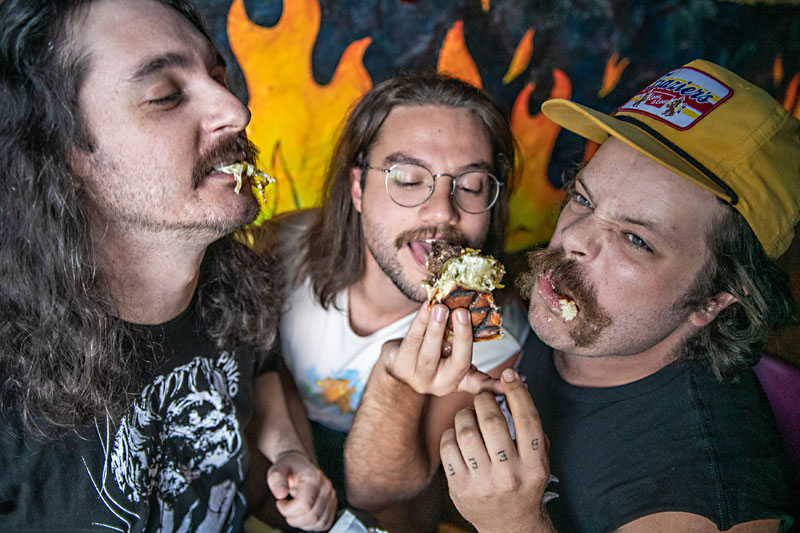
Rickshaw Billie's Burger Patrol - Death Wagon


 #Rickshaw Billie's Burger Patrol #heavy metal #stoner metal #stoner rock #fuzz rock #animated music video

Space: A treacherous realm where terrifying unknowns eclipse manifest hazards. For example, if one’s spacesuit rips, they fall unconscious before swelling into a bloated mass in mere seconds. And when encountering a black hole, prepare to be stretched into human linguini. Still, what about wild card dangers – aliens, galactic hostage taking, burger babes?
Austin trio Rickshaw Billie’s Burger Patrol ventures to the stars on brand new album Burger Babes from Outer Space - 8 terrifying tales of death to investigate. Is space really the place for a greasy rock band? The adventure unfolds today with a video for “Death Wagon,” animated by Katie McDowell and shot by Billie Patterson, in which members Leo Lydon, Aaron Metzdorf, and Sean St. Germain rocket through the cosmos on a sweet cheeseburger shaped craft until something goes horribly wrong. The expanse beyond our third stone from the sun swirls in silence, but not so when RBBP arrives. In “Death Wagon,” the unit blasts a sonic groove epitomized by Lydon’s exquisitely distorted 8-string guitar/bass hybrid and high vocals. Eventually, the track opens up into a near death metal squall that proves the perfect soundtrack for having your head torn off by the force of an exploding star.
Of the new album, Lydon reveals: “The Burger Babes have always been a symbol of feminism and power. I thought it would be cool to take them into outer space as a superior race of beings that were for peace, but instead, all the Earth guys start catcalling and whistling and try to pick them up, so they end up ‘evaporated’ by space weapons. It’s a very Mars Attacks kind of premise, I guess, but ‘Death Wagon’ comes into play from being in the road. Our van is the spaceship or death wagon. The whole thing is a metaphor for sacrifice and connecting, and giving your life to your art until eventually you die doing what you love. That spaceship burns and explodes as it enters the atmosphere, but no one will ever forget how bright it was when it did.”  From: https://www.austinchronicle.com/daily/music/2020-11-13/watch-rickshaw-billies-burger-patrol-die-in-space/