Rosalie Cunningham, well known on progressive rock circles as the driving force behind the well-received band Purson, grew up in a home with music all around her. She was writing her own songs and picking out melodies on a piano before, at 12 years old, she began seriously learning the guitar. With an ear for The Beatles, early Pink Floyd, David Bowie, Small Faces, Genesis and Black Sabbath, she had musical tastes beyond her years. At 13, she formed her first band, Suzie's Lip. Her first professional band, Ipso Facto toured with Magazine and The Last Shadow Puppets. In 2011, she formed the band Purson, which spread her music around the world, and culminated with the highly acclaimed album, Desire's Magic Theatre. Since the breakup of Purson, Rosalie has worked towards a solo career, and released her self-titled album in 2019.
Her first solo album was excellent, but here on her second, I feel she has outdone her previous masterpiece, Purson’s ‘Desire's Magic Theatre’. While her self-titled solo debut is beautiful and superbly crafted, on this one she has re-energized her progressive leanings with a vengeance. Her wit and whimsy are still on full display here, and I would say even more so than on DMT. I am tempted to mention my favorites from her lyrics, but I think each listener should experience the joy of hearing her words by listening to the album themselves. Every track is exquisite prog, and Rosalie manages to create perfection in every style she weaves into her compositions, be it symphonic, jazz, honky-tonk, and even a Beatles-like raga. Speaking of which, ‘Tristitia Amnesia’ absolutely blows me away, starting with the above-mentioned raga, and seamlessly escalating into an amazing psychedelic rock finale. I've mentioned this about her previous albums, but I find that Rosalie is one of the few artists whose albums consistently make me feel like I did a half century ago, when I would come home with a pile of records and find some that would send my mind soaring to new places. In simple terms, her music makes me feel young again.
From: https://www.progarchives.com/artist.asp?id=11303
DIVERSE AND ECLECTIC FUN FOR YOUR EARS - 60s to 90s rock, prog, psychedelia, folk music, folk rock, world music, experimental, doom metal, strange and creative music videos, deep cuts and more!
Saturday, June 14, 2025
Rosalie Cunningham - Number 149
Polyphia - Look But Don't Touch
Guitar-bending instrumental group Polyphia have distinguished themselves as prog rock mavericks, playing a style that falls somewhere between blisteringly fast metal-god virtuosity and pure pop. They first grabbed attention in 2013 after the track "Impassion" went viral. Since then, albums like 2014's Muse and 2016's Renaissance have found them further honing their technically brilliant instrumental sound, combining sophisticated pop hooks with face-melting guitar solos. Later on, the group added elements of hip-hop, EDM, and jazz to their repertoire with diverse outings like New Levels New Devils (2018) and Remember That You Will Die (2022). Formed in the quiet suburban landscape of Plano, Texas in 2011, Polyphia initially consisted of dual lead guitarists Tim Henson and Scott LePage, bassist Clay Gober, and drummer Brandon Burkhalter. They released two EPs, 2011's Resurrect (their only recording to feature vocals) and 2013's Inspire, before recording their 2014 full-length debut, Muse. Funds for the recording and production of Muse were raised by the band in an online fundraising campaign to which fans generously donated. The self-released album charted in the Top 100 of Billboard's album chart, and Equal Vision signed Polyphia, reissuing the album in 2015. From: https://www.allmusic.com/artist/polyphia-mn0003313453#biography
October Project - Funeral In His Heart - Live on FX 1995
With their unique blend of pop, classical, a cappella, and choral, October Project have carved a distinct niche in the landscape of independent music. Known for their lush harmonies, sweeping melodies, and warm and reflective lyrics, the New York group found critical and commercial success with the release of their 1993 self-titled debut and sophomore effort, 1995's Falling Farther In, but splintered shortly after the latter's release. A slightly re-tooled lineup returned in the 2000s and released a series of EPs, and in 2015, the band issued a full-length collection of choral recordings, The Book of Rounds. They returned to a more pop-driven style on 2024's Ghost of Childhood. Initially comprised of composer Emil Adler, vocalists Mary Fahl and Marina Belica, guitarist/vocalist David Sabatino, and poet/lyricist Julie Flanders, October Project honed their skills playing in friends' living rooms and small New York clubs, but they really constructed the specifics of their distinctive sound in the studio while in the process of recording their eponymous debut album. Released in 1993, Mary Fahl's unique and powerful voice was the focal point of the record, and the band's trademark vocal harmonies and soaring arrangements evoked classical choral music as much as they did alternative pop. The LP included the singles "Bury My Lovely" and "Return to Me," the latter of which appeared on the soundtrack to the 1994 action film Blown Away. Falling Farther In appeared in 1995 and yielded the singles "Deep as You Go" and "Something More Than This," but despite garnering positive reviews, Epic chose to sever ties with the group in 1996, and the band elected to part ways shortly thereafter. From: https://www.allmusic.com/artist/october-project-mn0000467881#biography
Steppenwolf - Sookie Sookie
Formed in Toronto and adding two Los Angeles-based musicians, Steppenwolf came on the music scene just as hard rock was heading toward its ascendancy. Looking for all the world like a biker gang, Steppenwolf could have been created by central casting to portray a hard-edged, leather-clad group of rockers. But Steppenwolf was a real group, taking its name from a 1927 novel by Herman Hesse and led by vocalist and guitarist John Kay.
Steppenwolf had released their debut single, “A Girl I Knew” b/w “The Ostrich,” in late 1967, but the 45 went largely unnoticed, making not a ripple on the singles charts. Both tunes would be included on the group’s self-titled LP, recorded in the fall of ’67 and released on January 29, 1968. In fact eight of the album’s 11 tracks would eventually appear on singles as the band’s reputation took off.
For that debut album, the band worked with Gabriel Mekler, house producer at Dunhill Records. Mekler’s résumé at that point was quite thin; his only previous production credits were three singles by the Dunhill act Lamp of Childhood. But working together, Mekler and Steppenwolf crafted a debut that defined the new rock subgenre that would come to be known as heavy metal. (The term would eventually come to represent a very different style of music, but in 1968, heavy rock meant Steppenwolf, Iron Butterfly, Blue Cheer and other loud, aggressive rock acts.)
Steppenwolf opens with the first of three cover songs, a reading of the 1966 Steve Cropper-Don Covay soul tune, “Sookie Sookie.” Where Covay’s original featured a prominent horn section, Steppenwolf’s version features distorted electric guitar. Kay and his band change the key, slow the arrangement down a bit, and mine the blues influences in the song. Goldy McJohn’s gurgling Hammond organ underpins the song while the guitar and rhythm section move it forward. Mid-song the band steps up a key as Michael Monarch takes a short electric guitar solo. More a groove than a song, “Sookie Sookie” nonetheless establishes the hard rock template upon which Steppenwolf would find its fortunes. From: https://bestclassicbands.com/steppenwolf-debut-album-review-11-27-177/
Baskery - Old Man (Neil Young cover)
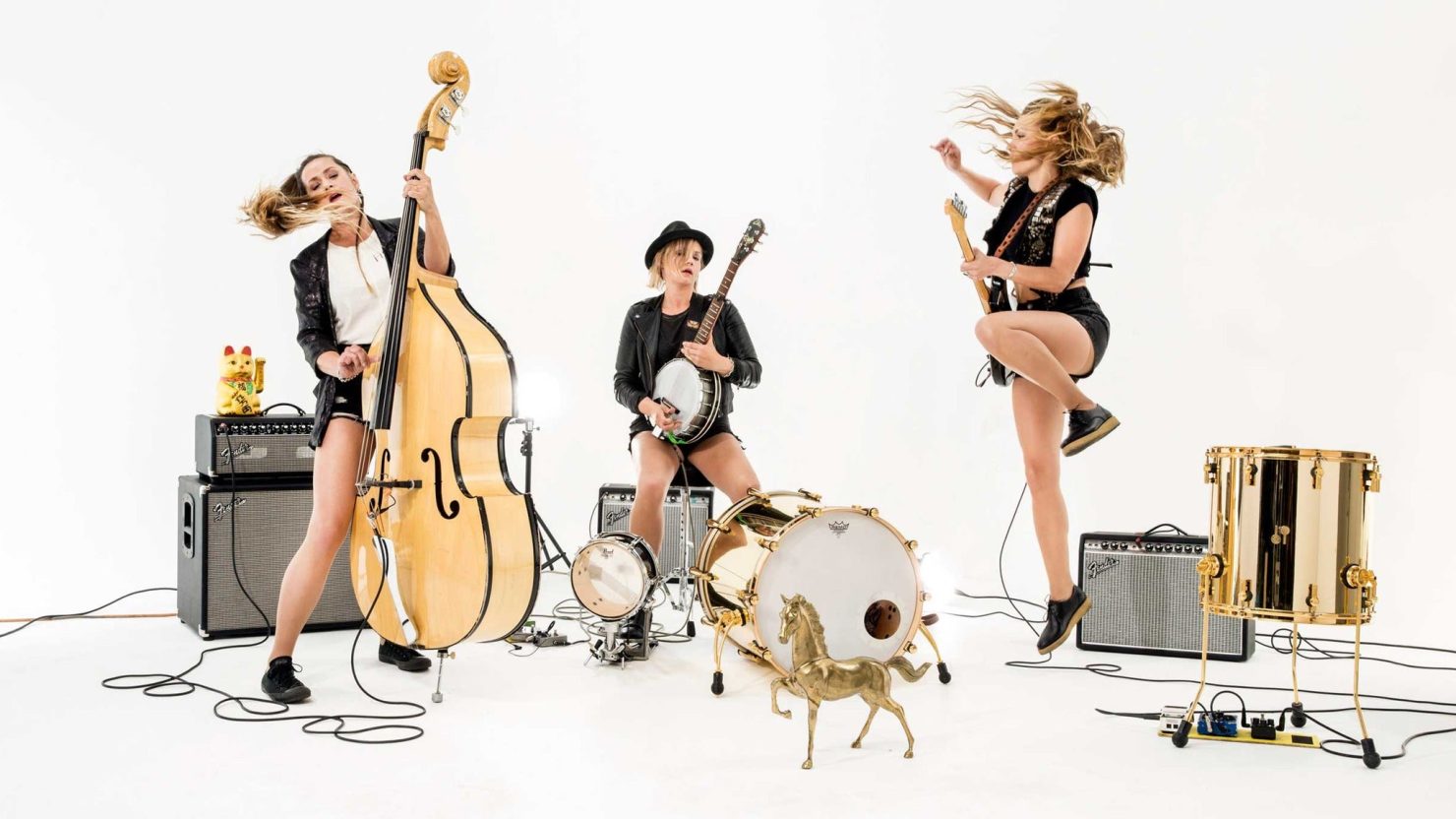
Baskery have never been shy of their influences, with the Swedish sisters indebted to the “file under country and folk” of North America. Although they self-describe their music as “killbilly”, or banjo punk, the reality is that they are a world apart from any of the frantic fringes of cowpunk, a closer reference point being maybe as an amalgam of the (Dixie) Chicks and the Roches. It is a good brew, though, and their previous releases contain a melodic fusion of country rock tropes. Greta Bondesson manages to combine playing drums with a guitar/banjo hybrid, with sister Stella playing bass and sister Sunniva handling guitars and cello. All sing, their sibling harmonies a characteristic feature. As well as playing all the instruments, the three usually write their own songs. However, The Young Sessions – Live to Tape sees them doing a cover album, selecting ten Neil Young tracks to cover, most of them from his 1969-1972 peak.
The Young Sessions opens with a medley of “Out on the Weekend/Don’t Let it Bring You Down/A Man Needs a Maid”, and that opening shot proves that Baskery has the Harvest soundscape down just pat. The drums mimic the simplistic metronome of the originals, and Greta’s harmonica is Shakey-level authentic. Indeed, so much so that, as the tripartite vocals come in, it sounds… odd, a little Chipmunks-do-Neil. Not to say they are shrill, sticking much to the singer’s own timbre; it is just the novelty of hearing three Neil-adjacent voices all at the same time. This is least apparent for “Maid,” given, clearly, no orchestration, leaving the sisters to garnish it with just what they have to hand, which makes for a first hint of new light through the old windows.
“Old Man” returns to superior karaoke, but the sibling harmonies make the exercise worth that conceit. The sound of the guitar/banjo hybrid gives an idea of the instrument’s capabilities, it sounding actually exactly as billed, the plucking pitched between the sonic of both instruments. “Heart of Gold” actually benefits from this, not least as it granted some slide styling for the familiar riff.
“Alabama” is the first to have you wonder whether the sisters are up to reproducing the idiosyncratic boxing-gloves guitar style of Young. The answer: nearly, if more in spirit than execution, the soloing more prosaic and decidedly more conventional. It’s fine, but there remains a yearning for the cack-handedness of the original.
That said, spotting a running time of over 10 minutes for “Down by the River,” the feel is, and the hope stronger, that this is maybe where Baskery let rip. And, as they begin, they deliver a wonderfully aspirational assault. The interplay between orthodox guitar and the hybrid is superbly monosyllabic and repetitive, where each of these are essential facets of the Neil Young Experience. For me, this is where the album comes suddenly to life, my hand casually dialing up the volume, and then some more. Too late for our best covers of the year list, this song might have had my vote. From: https://www.covermesongs.com/2024/12/review-baskerys-the-young-sessions-live-to-tape.html
Millionaire - I'm Not Who You Think You Are
Millionaire have released LP number four Applz ≠ Aplz (pronounced Apples Not Apples), a burst of psychedelic rock n roll energy with a soul twist wrapped in a celebratory flavour, while exploring themes of consumerism, environmental destruction and the peril humans are facing, largely due to our own hand. Millionaire founder, songwriter and multi-instrumentalist, Tim Vanhamel talks to Gimmie from his home in Belgium.
Why is it important to you to create things?
Tim Vanhamel: Let me think about that, that’s a good question. I have no idea. I was contemplating that yesterday actually. It just happens in a way. If you want to give it importance then it usually is not that good, it’s more the ego trying to do something or create or whatever. It’s best to just let it happen, it doesn’t matter what it is, whether it’s making a dish or making a song or making a little video, or just singing to yourself or making a joke. The best creativity just comes up, there’s a need to.
I know what you mean. At Gimmie we love making things, we feel we just have to. It is hard to explain. There’s just something there that needs to come out, that needs to express itself.
TV: Yeah, exactly. I can see that with you guys. It is what makes you feel good in a way, if it makes you feel good doing it then the art is usually good and other people will like it as well. We all do different things and sometimes, writing a song in my case, if it’s not happening that’s fine, then something else can happen.
I saw you mention online the other day that because you’re in lockdown at home you’ve been writing and painting?
TV: [Laughs] That was a joke actually! I’ve been making these little films the last week. I posted one and I was making a little fun about how all these people feel called to live stream and how they feel like, “oh I gotta help the world”. The world doesn’t necessarily need help, in the way that everybody is locked down, mediocrity is really coming out. It was a little joke I was posting. People were like “Oh, it’s a lockdown, we have to be creative! I’m gonna write a new album”. I made a joke that I was doing six paintings and writing two books and doing a movie script [laughs]. I then made a second film and then it became kind of a thing, a character that was playing a song but it just never works out, everything goes wrong; he was trying to get a song going for everyone but he kept failing all the time. That’s also creative though, I was following that creativity, that need to share a joke.
I think laughter is important in these tough times.
TV: Exactly, I think that laughter is one of the highest goods in the world. People are really serious, also with sharing all this advice… everyone is so serious. A good laugh is good, it’s a high good and when we laugh we are what we’re meant to be as human beings; we’re ourselves and there’s no war going on. It’s fantastic.
Everything that’s happening in the world is so crazy and intense right now, consumerism and capitalism is finally failing! In a crisis like we’re experiencing, people are realising that they don’t need all the excess stuff they fill their lives with, all the luxuries they usually take for granted and don’t think twice about.
TV: Yeah, it’s not so crazy though. As you know I just released an album and I am singing on that album about everything that is happening right now!
You are!
TV: Everything that’s happening, I could feel it already about a year ago. The first song “Cornucopia” is about consumerism etc. The second song “Los Romanticos” is about there’s a shit storm coming and its moving fast, it’s an ironic song about how supposed love eats up the world, it’s not true love, it’s false. The third song “Strange Days” I’m singing about doing nothing, I’m literally singing: “when the world ends I will be watching from a front row seat, you bring the thunder, I’ll bring the lightning and maybe we can meet for the very first time…”, it’s not to pat my own shoulders but this is exactly what’s happening. I don’t think there’s another song in the world that’s more true than that right now. I can’t believe it. A week ago the album came out and I did a bunch of interviews, which I don’t really like doing, I don’t like explaining my songs… it’s bizarre that five days after I released my album everything happened big time!
Your new album is great! I like how in interviews you rarely talk about your songs, I know you like people to have their own interpretations of your songs, to think for themselves about it. Like with something like all the visuals to accompany the album, the cover art, film clips, they feature the apple and that right there has so much symbolism attached to it throughout the history of the world and can have so many different meanings.
TV: Exactly. Explaining art is like the Wizard Of Oz pulling back the curtain and then you have a little man in a machine sitting there and the magic is gone. If it was my choice, I would never ever, ever say one word, I wouldn’t explain nothing. I try to boogie around those questions. [Laughs].
From: https://gimmiezine.com/2020/03/31/millionaire-interview/
Disappear Fear - Live TV 1994
Disappear Fear, formed in 1987, consisted of sisters Sonia Rutstein and Cindy Frank, and expanded the following year to include guitarist Howard Markman. Their lyrics often addressed love, life, Baltimore, LGBT rights, and progressive political issues. The pair released six albums as a duo. In 1994, after self-releasing their music via their own Disappear Records label, the band was signed to Rounder/Philo Records. Two years later, Cindy stopped performing regularly with the band in order to focus on her growing family. Cindy's teen son Dylan Visvikis has shared his talents on vocals and piano. From: https://en.wikipedia.org/wiki/Disappear_Fear
-
Meet the Band: Fatal Flaw The band: Joel Reader (voice, bass) is a recent transplant from San Francisco; Zack Wells (guitar, voice) and Josh...
-
For those potentially out of the loop, Townland is a Los Angeles-based project that’s made up of Shannon Locke (lead vocals), Matt Gourley (...
-
Right after a band’s name, how a group comes together and not only grows, but sustains—and in the case of folk trio The Wailin’ Jennys, sust...
-
The Obelisk Questionnaire: Duncan Park of Return to Worm Mountain, Rise Up Dead Man & More. How do you define what you do and how did yo...
-
Such was the way of the music industry in 1970 that Free were back in the studio on August 21st barely a few months after the release of the...