Tuesday, March 14, 2023

Richard & Linda Thompson - A Heart Needs A Home


 #Richard & Linda Thompson #folk rock #British folk rock #contemporary folk #singer-songwriter #ex-Fairport Convention #1970s #music video #The Old Grey Whistle Test

Richard Thompson left Fairport Convention after 1970’s Full House, his reputation secured as an excellent songwriter and guitarist. He released a spectacularly unsuccessful solo album, Henry the Human Fly, in 1972. He then married Linda Peters and they released six albums between 1974 and 1982; their relationship broke down before an ill-fated North American tour in 1982. The duo’s music is often melancholic, and it’s a common trick of Richard Thompson to pair upbeat music with depressing lyrics. They often play acoustic folk-rock, especially on their early albums, but 1978’s First Light uses an L.A. rhythm section and 1982’s Shoot Out The Lights has few vestiges of folk remaining. Linda and Richard share the vocal duties – while Richard’s gruff voice is limited, Linda’s pristine voice is able to capture a range of moods, from joy on ‘I Want To See The Bright Lights Tonight’ to resignation on ‘Walking on a Wire’. The pair’s first album, 1974’s I Want To See The Bright Lights Tonight and their 1982 swan song Shoot Out The Lights are generally considered as their strongest. In between they spent time in a Sufi Muslim commune, taking three years away from music. Richard has stated that he considers their late 1970s albums as weak, as he didn’t have his mind on the job.  From: https://albumreviews.blog/reviews/1970s-album-reviews/richard-and-linda-thompson/

Linda Thompson's experience with Sufism was, by her own reckoning, not such a good one. She moved to a commune in Maida Vale with Richard, then her husband, after making "Hokey Pokey," and she describes her experience there as grim and self-punishing. For awhile, Richard's mullah told him not to play the guitar, so he didn't play the guitar. Richard & Linda Thompson, British folk-rock royalty, disappeared for a few years in the mid-'70s. Before they did, they sent this epistle. "A Heart Needs A Home" pointed straight toward the "Pour Down Like Silver" LP, Thompson's most explicit bout of Sufi songwriting. "Home" caps "Hokey Pokey," a collection of songs that describe the world as a cold, forbidding, sin-soaked place. Richard Thompson turns to Allah in emptiness, and finds fulfillment there. Odd, then, that he didn't sing it. He gave the song to Linda. Perhaps he identified with her so strongly back then that he felt no separation between his perspective and hers. Or maybe he was trying to convince her of something. Since leaving the commune (and the marriage), she's occasionally suggested that her heart was never really in it; that she followed Richard to Maida Vale because she loved him, and she wore the headscarf because that's what was expected of her. Do we believe her? She certainly does not look uncomfortable singing "A Heart Needs A Home." On the contrary: Linda Thompson is completely possessed, her eyes on the great beyond. Maybe she's singing about Richard, maybe she's singing about Allah. Maybe it doesn't matter. The Sufis have a concept called wahdat-al-wujud: God is the only reality, and all that we perceive is a decipherable pattern emanating from Allah. Nothing exists that isn't a piece of the divine. Linda might have got it better than the mullah did. She might have got it better than Richard did.  From: https://www.nj.com/entertainment/music/2010/08/song_of_the_day_a_heart_needs.html

The Neptune Power Federation - Watch Our Masters Bleed


 #The Neptune Power Federation #hard rock #stoner rock #occult rock #stoner metal #Australian #music video

Like all great threats to decency, the church of The Neptune Power Federation was born far from the tired gaze of the masses. Operating out of dive bars and biker clubhouses, playing to troubled souls with dirty hair and crude intentions, their high volume psychedelic gospel spreads like a glorious subterranean infection.  From: https://theneptunepowerfederation.bandcamp.com/community

10 Megatons of neanderthal rock fuelled by satan and space hallucinogens. Without doubt the Neptune Power Federation are the best live band playing in Sydney at the moment. A band comprised of musicians with the hard won skill earned through a lifetime of rocking deals out a feast for both the ears and eyes. Riffs that we all thought were forbidden are wielded with joy and crunching power whilst the Imperial Priestess Screaming Loz Sutch aka The Rat Queen presides above it all; mocking the heavens, defying hell and laying waste to any mere mortals foolish enough to stand in her path.  From: https://www.bandsintown.com/a/2387664-the-neptune-power-federation
 
I have always loved storytelling. As a child I rapidly ran out of interesting books to devour in the library, and nowadays I get my fill with online free-form role playing. This extends to music as well; a cool concept can really elevate an otherwise unremarkable album. What a good story needs first and foremost is interesting characters though, and The Neptune Power Federation get that. Their vocalist, Imperial Priestess Screaming Loz Sutch, assumes the mantle of a time-travelling space witch for their fourth album, Memoirs of a Rat Queen. 70s space rock that mixes Heart with Hawkwind and AC/DC, a sexy vengeful bombshell on the mic, and a story scattered from the French revolution to boning in a parking lot; what could possibly go wrong here?
I guess we won’t find out, because not much does. That largely comes down to the Imperial Priestess. Like an Oscar-worthy actress, she completely falls into the role. Her character is straight out of a Neil Gaiman novel, a demi-goddess of lust and wrath, of regal rage and justified arrogance, and you believe her every syllable whether she sneers about the deaths of her enemies (“Rat Queen”: ‘Their last words as they fell / were damn that bitch to hell!’) or seduces a mere mortal with her eons of experience (“I’ll Make a Man Out of You,” not even close to a Disney cover!). It certainly helps that her technical skills are off the charts. Her voice is razor-sharp. Some might consider her too shrill, but she conveys supreme passion and power, and with a few momentary exceptions, she is always in complete control of her vocal chords and her role alike.
All that would go nowhere without solid songwriting, and boy, are there some fucking jams on this platter. “I’ll Make a Man Out of You” is both incredibly seductive and a fantastic fist-pumper, reminiscent of the very best glam ever had to offer. “Rat Queen” has more hooks than an angling store and more girl power than a female bodybuilder competition, while single “Watch Our Masters Bleed” goes from reflective reverence to rousing revolution. Every track has a different vibe, thanks to the distinct hooks as well as selective use of classic instrumentation, like the cowbell in “I’ll Make a Man Out of You” and the Hammond organ blasting throughout “Pagan Inclinations.” Traces of soul are plentiful, thanks to the frequent female choir piping in, giving a gospel atmosphere to the electrifying boogie space rock anthems.  From: https://www.angrymetalguy.com/the-neptune-power-federation-memoirs-of-a-rat-queen-review/


Nurse With Wound - The Bottom Feeder


 #Nurse With Wound #Steven Stapleton #experimental #industrial #avant-garde #noise #dark ambient #drone #sound collage #plunderphonics #animated music video #stop-motion

A challenging, amorphous entity that has revolved around Steve Stapleton for almost forty years, Nurse With Wound has operated at the vanguard of industrial, drone and ambient music with fearless clarity. Steve Stapleton’s Nurse With Wound project is regularly positioned in the same universe as Current 93 and Coil on the basis of shared roots, ongoing social connections and a vague genre definition. What really unifies NWW with the other two, however, is the sheer uniqueness of the musical vision at play - each band has defined a sound world that echoes known genres, while belonging to any and all they might wish. In the case of Stapleton, his work has rarely featured a front-man or a conventional vocal presence, meaning the focus has always been on his abilities to reinvent and reimagine sounds in new contexts and new situations via his skill as a sound collagist. His focus on the moods and emotions evoked by what he creates has ensured a truly expansive set of alternative visions within his long discography.  From: https://thevinylfactory.com/features/an-introduction-to-nurse-with-wound-in-10-records/

As a testament to the random disorder and beauty of life, London’s Nurse With Wound (Steven Stapleton) functioned outside the normal musical channels for a decade, experimenting with tape collages of disjointed phrases, improvised music, electronics and found sounds on a series of intriguing, provocative, humorous and frequently entertaining self-released records. Between 1978 and 1988, Stapleton collaborated with such likeminded sonic adventurers as David Tibet of Current 93 and Tony Wakeford of Sol Invictus to produce a prodigious body of work that embraces surrealism in both content and graphics.

NWW’s debut, Chance Meeting of a Sweing Machine and an Umbrella on a Dessecting Table, welds introverted, spacey guitar to converging hemispheres of intergalactic blips. Then, like much of the band’s music, it veers into sketchy doodles: between intermittent lulls of humming and buzzing, there are bursts of frenzied screeching, torture chamber screams, piano scales, women speaking French, etc.

To the Quiet Men From a Tiny Girl resembles a nest of vibrating insects, with clinking chains, someone practicing saxophone, an operatic soprano and other voices. “Ostranenie” suggests a house of a hundred rooms — with a different noise in each.

Merzbild Schwet is as challenging as a Buñuel film, with repeated lines (like “We have fallen silent - lost the power of speech - our heads are empty”) as women laugh and sing. Other ingredients: clanking, ripping velcro, angry voices and something like a sick elephant honking.

Those first three albums were later reissued in a CD boxed set (Psilotripitaka), which also includes Ladies Home Tickler, another bizarre cut-up collage: snippets of sappy tunes, electrical noises and taunting laughter. Present the Sisters of Pataphysics compiles passages from the first three LPs.

The avant drippings on Sylvie and Babs — the most guest-laden NWW effort, with dozens of contributors as opposed to the usual one or two — include more laughter and repetition of the word “pardon.” The two Automating albums collect material from the many compilations to which Nurse With Wound has contributed. Slices of show tunes, repetitive background beats and advice like “Never eat anything bigger than your head” are sprinkled throughout. Volume II addresses the hierarchy of biological existence; one segment could be the soundtrack for a science fiction feature about giant rampaging tarantulas.

A pair of 12-inch EPs paired as an album, Gyllensköld bristles the coarsest of hairs with scratching and horror dungeon screams while Brained adds the demonic voice of Clint Ruin yet contains a movement that could accompany an underwater Cousteau documentary.

A Sucked Orange offers 20 experimental vignettes, many of which justify their titles: the scraping murmur of “Flea Bite,” the repetitive clank of utensils beneath a spoken loop of “It ain’t necessarily so” on “It Just Ain’t So,” the catchy ditty plinked out on “This Piano Can’t Think.”

Soliloquy for Lilith is Stapleton’s surprising chef d’oeuvre, a three-album box of contemplative, atmospheric experiments employing treatments of a stringed instrument of his own invention.

Over time, however, the group’s usual organized chaos gained a certain predictability. At the end of 1988, Stapleton moved to a farm in Ireland.

More accessible than much of Stapleton’s ’80s work, Rock ‘n Roll Station is rhythmic almost to the point of being dancefloor-friendly. The combination of rhythms, noise and ambience is in line with work done in the mid-to-late-’90s by artists on the Warp label. The title track begins with a clipped rhythm aided by random vocal samples; “The Self Sufficient Sexual Shoe” repeats the idea with male vocals replaced by female whispers. “Two Golden Microphones” is a multifaceted 17-minute sonic beast that throws together fragments of pop songs, surf instrumentals and tribal rhythms. “A Silhouette and Thumbtack (A Dance in Hyperspace)” slides from spooky ambience to a beat interrupted by random samples/noise. “R+B Through Collis Browne” works together female screams and guitar samples. The disc ends with three minutes of “Finsbury Park, May 8th, 1.35 pm (I’ll See You In Another World),” ambient-drone accented by a thumping beat.

From: https://trouserpress.com/reviews/nurse-with-wound/


Steven Stapleton

First Aid Kit - War Pigs


 #First Aid Kit #indie folk #Americana #country folk #folk rock #folk pop #singer-songwriter #Swedish #Black Sabbath cover #music video

You wouldn’t imagine that the mellow folky tones of First Aid Kit would pair well with the frenzied howling maelstrom of Black Sabbath. Sometimes defying convention is a thrill and music proves that time and time again. In fact, defying convention is something that First Aid Kit have had to do in their own usual field anyway. "We had a lot to prove, especially being in a genre that’s dominated by a certain type of man – you know, nerdy, bearded men listening to folk,” Klara Söderberg told The Telegraph. “We felt we had to prove we were serious about music and we weren’t just doing this because we thought it was trendy.” Her sister Johanna adds: “I felt there was a lot of sexism in that as well.” Thankfully, they persevered and have been offering up blissful music ever since, not least last year’s cracking album Palomino. Throughout their musical journey so far, they have remained defiant enough to venture into a range of genres and let their individualism and undoubted talent shine through.
That’s just as well when it comes to covering Black Sabbath because very few songs have the raw, mystic power that the anti-war juggernaut of ‘War Pigs’ contains. It is, in essence, an outcry. “Britain was on the verge of being brought into the Vietnam War,” Geezer Butler recalls, “there was protests in the street, all kinds of anti-Vietnam things going on. War is the real Satanism. Politicians are the real Satanists. That’s what I was trying to say.” The anthem remains one of the great opening tracks, blasting Paranoid off like the gunshot at the start of a race. Everything about the band was rough, tumble, and raw. Even their debut album was pieced together in a day, as Tony Iommi recalls, “We thought we have two days to do it and one of the days is mixing. So we played live. Ozzy was singing at the same time, we just put him in a separate booth and off we went. We never had a second run of most of the stuff.” While Ozzy Osbourne’s thunderous screech is hard to match, the duo bring their own sense of power to it. As Alex Turner of the Arctic Monkeys once correctly identified, there is just something special about siblings harmonizing.  From: https://faroutmagazine.co.uk/first-aid-kits-cover-black-sabbath-war-pigs/

Saddhu Brand - Whole Earth Rhythm


 #Saddhu Brand #psychedelic folk rock #acid folk #world music #Indian classical #1970s 

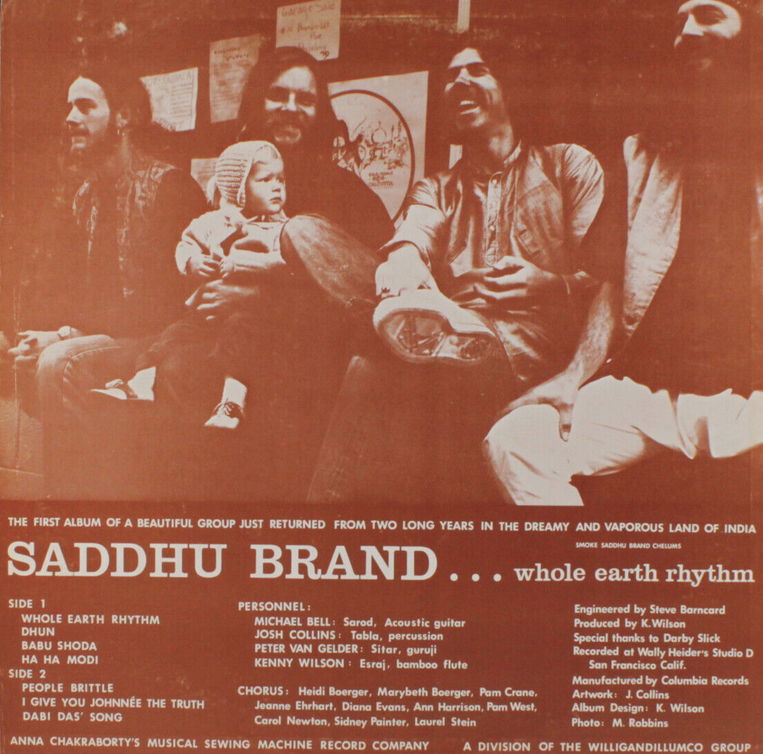
This is what happens when you get four hippies back in San Francisco after a four year layover in India. Sounding strangely burnt out yet happy, the songsters of Saddhu Brand stick exclusively to traditional Indian instruments and vocals. The vocals come in two varieties: the strangely unemotional sounding female chorale vocals and the voice of one addled guru sort of fellow by the name of Peter Van Gelder (from Great Society).
In many ways, this disc makes me think of a weird transmutation of the British freak-folk scene. There's a kind of Incredible String Band vibe here, although this band has a different set of acoustic instruments and they're nowhere near as talented as the ISB. The whole affair reeks of patchouli (or let's say Nag Champa, I hate patchouli), but what we have here is for the most part a typical San Fran band thrown through a Hindu blender. "People Brittle" would easily translate to a later period Jefferson Airplane song with electric Western instruments, and "I Give You Johnee The Truth" is only one step removed from sounding like West Coast "cowboy" music like New Riders Of The Purple Sage. Just get a different singer and ditch the flute and sitar. Of course the charm of this albums is that it does have the aforementioned flute and sitar.
On the longer tracks "Babu Shoda" and "Dabi Das' Song" the band tries their hand at more authentic Indian style compositions. It's not going to stand in my way if I'm reaching for a Ravi Shankar record, but it's enjoyable enough. While they do whip up a wild dervish sort of sound on the later track, it's far muddier and less precise than something similar that the Indian masters would concoct. Whole Earth Rhythm threatens to confirm more than one cliche concerning the late 60's. If you can stomach that and enjoy Indian instrumentation, you'll probably find something to enjoy.  From: http://psychedelicobscurities.blogspot.com/2007/09/saddhu-brand-1970-whole-earth-rhythm.html

Nickel Creek - When in Rome


 #Nickel Creek #bluegrass #folk #contemporary bluegrass #progressive acoustic #Americana

Today, the music community broadly known as Americana has too many stars, scenes and subcategories to count. Beloved artists like Jason Isbell and Kacey Musgraves, who in another era might have been all but ignored by country gatekeepers, have found a welcoming community and something in the neighborhood of household-name status. The Americana Music Festival, held annually in Nashville, grows larger each year. And in 2014, the Grammys gave the first awards in the newly created "American roots" categories, which encompass bluegrass, blues, folk, gospel and anything too left-of-center for the country mainstream. But the music under this umbrella wasn't always the stuff of major festivals and glitzy awards shows, or of such broad interest to the youth market whose tastes drive the industry. At the turn of the 21st century, progressive-minded artists in this world were likely to be scattered across granular labels like contemporary folk or the then-popular "alt-country," with smaller audiences and fewer entry points for a casual listener. As it still does today, country radio leaned heavily commercial (though it did, at least, play music by women back then): In 2000, the songs that dominated genre playlists before finding crossover success were pop smashes like Faith Hill's "Breathe" and Lee Ann Womack's "I Hope You Dance." Traditionalists, meanwhile, carried on in the passionate but niche scenes they had occupied for years.
Then, 20 years ago this month, an album arrived that seemed to speak all these languages at once: unafraid to push the boundaries of its primary genre, and packing the musical chops to bring such an eclectic vision to life. Behind it were three musicians just barely old enough to vote. When Nickel Creek released its breakthrough album on March 21, 2000, the players comprising the California-born bluegrass trio were anything but newcomers: Chris Thile and siblings Sara Watkins and Sean Watkins had been playing together since 1989, when Thile and Sara were just 8 and Sean 12. The young talents had already released two studio albums as well as a handful of solo projects, and were regulars on the bluegrass festival circuit, a tenure that had refined their sound to a level typically reserved for older players with bigger discographies. Still, despite arriving with a pages-long resumé, Nickel Creek is still popularly thought of as the trio's debut — perhaps because, in retrospect, everything about it seems to signal a new beginning.
Both to mainstream ears and those steeped in string music, what Nickel Creek was doing sounded fresh. The three musicians, then aged 18 to 23, found creative and playful ways to infuse bluegrass music with ideas from jazz, classical, pop and rock. They put traditional songs next to original material about characters from The Lord of the Rings. Perhaps most impressively, they did so in a way that felt cohesive, as though the new approach they had forged for themselves had roots as deep as bluegrass itself. Working in a genre known to spark arguments over what counts as "authentic," the trio seemed far more concerned with realizing its own vision than hewing to hardline conventions — like sticking to a repertoire of mostly folk songs and standards, using common chord progressions or relegating the guitarist to the rhythm section. (And how fortunate that Nickel Creek didn't, as Sean Watkins' masterful guitar solos are always album highlights.)
There was some precedent for this kind of deviation, of course. Veteran genre agnostic Béla Fleck, who made his studio debut in 1979, had racked up accolades for his singular take on banjo playing, which often treads closer to jam and world music than to traditional American bluegrass. Alison Krauss, who would be integral in bringing Nickel Creek to a wider audience, toyed with pop and rock tropes alongside her band Union Station, and is often considered a primary influence on the "newgrass" movement. In 1998, Lucinda Williams released her landmark album Car Wheels on a Gravel Road, which won the Grammy for best contemporary folk album. The same year, Wilco released its first Mermaid Avenue team-up with Billy Bragg, which featured new songs built around previously unheard lyrics by Woody Guthrie. The album was a critical and commercial success. While nonconformists had found room in the conversation before, there was still something novel and uniquely compelling about the sight of three musicians, two in their teens and one in his early 20s, who revered Bach and Bill Monroe in equal measure. Krauss agreed, bringing the trio to Sugar Hill Records and producing Nickel Creek herself. Already a multi-Grammy winner upon meeting the group, Krauss had found great success both in bluegrass and adult contemporary, making her uniquely qualified to shepherd such an unconventional young act.
From: https://www.npr.org/2020/03/13/814739478/nickel-creek-self-titled-20-years-americana-roots-folk-country

Candelilla - 17


 #Candelilla #indie rock #post-punk #noise rock #experimental rock #dark cabaret #German 

Candelilla - "little light" - somehow doesn't want to go with the loud, angry and urgent songs of the band from Munich. However, Mira Mann (vocals, bass) and Lina Seybold (vocals, guitar) bring the name with them from their school days, where they met through music in 2001. Things really got going in 2007, when the two found their perfect partners in crime in Rita Argauer (vocals, keyboards) and Sandra Hilpold (drums). Mann, Seybold and Argauer had already recorded three EPs with changing members and distributed them themselves, rehearsed in the Munich area and as the opening act for Slut.
"Don't Rely On What Others Say" is the name of the first 6-track EP after the rebirth; message and self-admonition in one. Punk rock meets sweet pop moments, quite playful at times, almost a little well-behaved. But Candelilla are already "addicted to hoarseness", as they cry out in the song "4". The songs have to do without names from now on, numbering is king.
In an all-girl band that doesn't play folky fairy songs, but rocks properly, of course everyone comes with the feminist club and the riot grrrl drawer, with Bikini Kill and Hole. But you shouldn't come to Candelilla with the "woman thing" (Argauer). Of course they are feminists, but they want to be seen as a band and not as a "women's band". "You also have to know that Candelilla's all-female cast was more of a coincidence, the girls used to play with boys before I joined, and I've also been in other bands," Hilpold reveals to the blog Mapambulo.
In 2009 the first official studio album was released on the local label Red Can Records. The quartet is still testing how much can be packed into a song without it completely falling apart. The sweet pop melodies have to make way for more noise, grunge and hardcore. The microphone wanders wildly around the band, they sing in English and in German, preferably in the same sentence.
Candelilla records the follow-up album with producer legend Steve Albini (including Pixies, PJ Harvey, Nirvana and his own band Shellac). And that appears after the band made a name for themselves in Germany, France, Spain and the UK on Zick Zack. After all, the original Hamburg independent label has always been a haven for the more interesting and smarter German pop music.
"Heart Mutter" will be released in 2013 and comes at a time when a few more German-speaking bands with anger in their stomachs and brains in their heads are making a name for themselves: Ecke Schönhauser, Messer, 1000 Robota, 206, Better Times and a few more. But Candelilla don't really want to fit into this 2010 new edition of the Hamburger Schule. They are a bit too noisy and grungy, too erratic and too multi-layered for that. Because the band's first motto is still to take it apart and put it back together again. So the numbering continues to make sense, as Candelilla tell Zündfunk: "Because the three of us write texts and like to chop things up, put them back together, rearrange them and let them run against each other, it is of course very important again in terms of content or meaning fitting to let number stand as a total abstraction."  Poorly translated from: https://www.laut.de/Candelilla